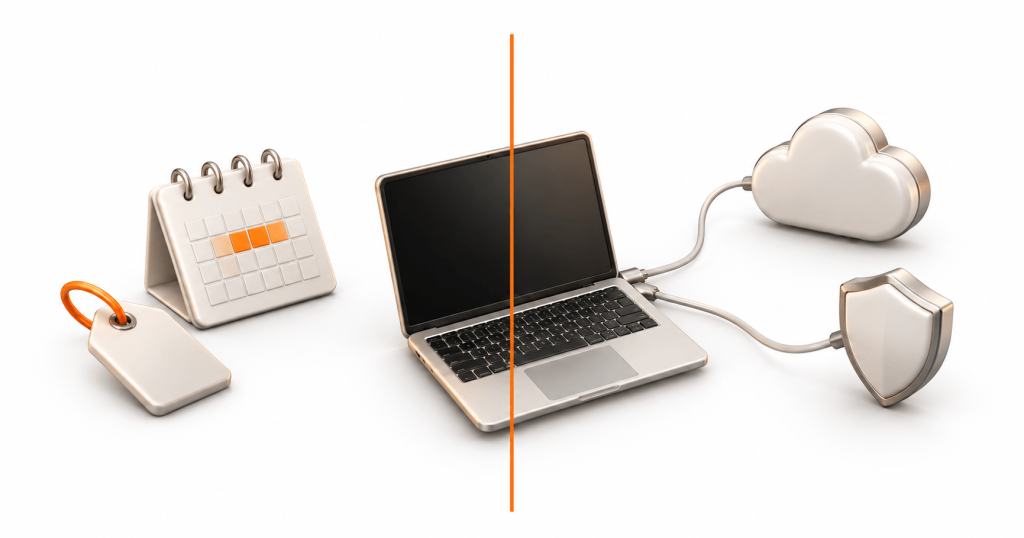
A server goes down at 2 p.m. Your CMDB tells you which three applications depend on it. Your ITAM tool tells you the warranty expired in March. Neither tells you that the laptop of the engineer who can fix it is still sitting in a former employee’s apartment in Austin.
That’s the CMDB vs ITAM question in one scene. Both systems track IT assets, both are central to IT service management, and teams often confuse them. But each answers a different question, and each has a blind spot.
TL;DR
- ITAM (IT asset management) tracks what you own, what it costs, and where it is in its lifecycle.
- A CMDB (configuration management database) tracks how IT components are configured and connected, and what breaks if one changes.
- Neither one tracks the physical device itself: where it ships, who has it, and what happens to it at end of life.
What is IT asset management (ITAM)?
ITAM is the practice of tracking every IT asset’s financial, contractual, and lifecycle data from purchase to disposal. It answers: What do we own, who has it, and what is it costing us?
A typical ITAM record includes:
- Purchase price, vendor, and purchase order
- Warranty and lease dates
- Assigned user and location
- Software license entitlements
- Depreciation and refresh dates
- Disposal method and date
ITAM is usually owned by IT operations, procurement, and finance together. The international standard for the discipline is ISO/IEC 19770-1.
What is a configuration management database (CMDB)?
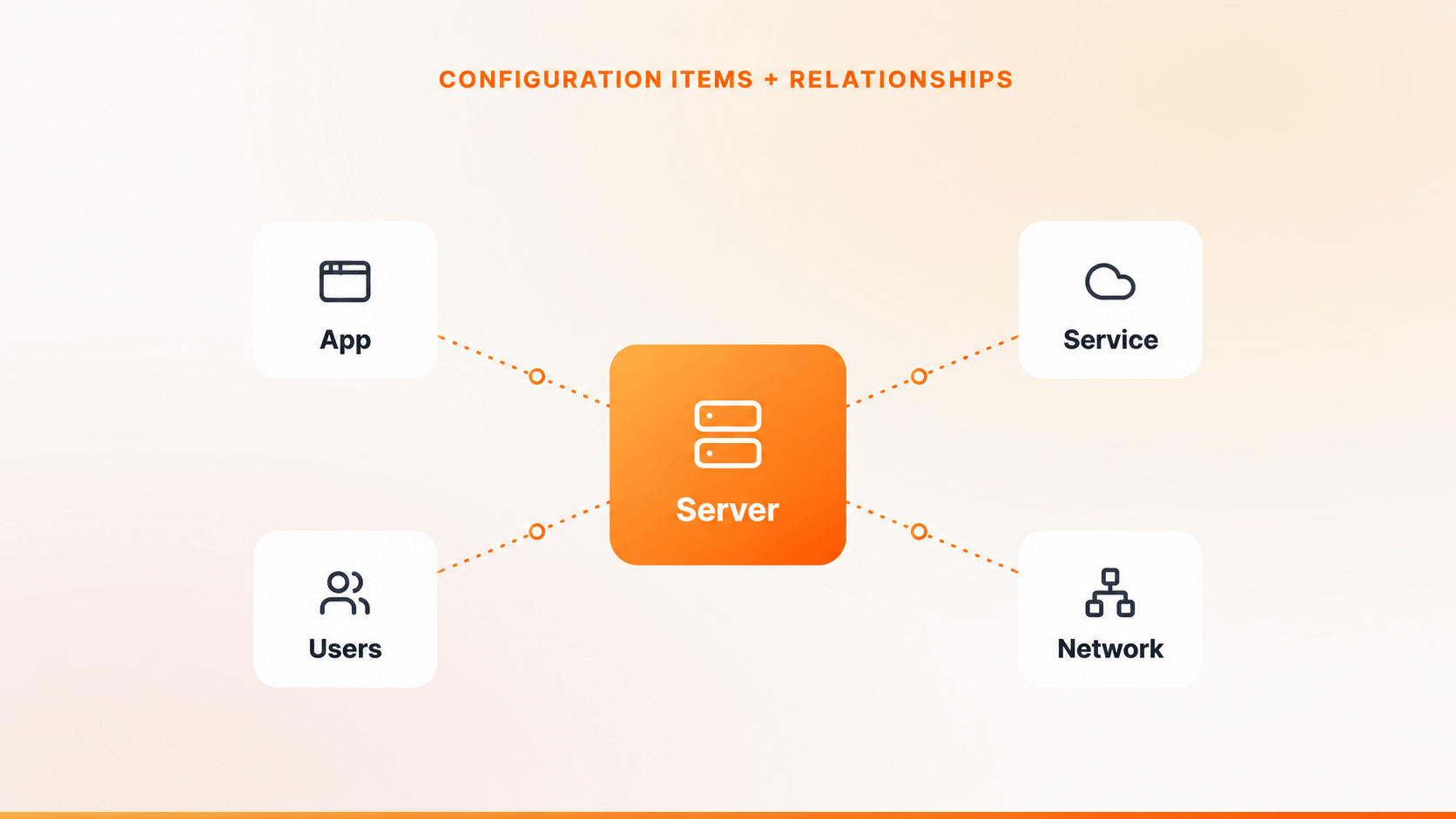
A CMDB is a database of configuration items (CIs) and the relationships between them. It answers: How is this configured, what does it connect to, and what happens if it changes?
Teams use the CMDB for incident, problem, and change management. When a change request comes in, the CMDB shows which services, users, and systems sit downstream.
That matters because outages are expensive. ITIC’s 2024 survey found that one hour of downtime costs more than $300,000 for over 90% of mid-size and large enterprises. An accurate CMDB shortens the time it takes to find the cause.
Asset vs configuration item: what’s the difference?
Take a remote employee’s laptop.
- As an asset, it’s a $1,600 machine bought on a three-year lease, assigned to a sales manager in Denver, with a warranty that ends in 2028.
- As a CI, it’s a device running a specific OS build, a VPN client, and an endpoint agent, connected to the CRM and the identity provider.
Same laptop, two views. ITAM cares about its cost and lifecycle. The CMDB cares about its configuration and dependencies. Not every asset is a CI (a monitor rarely is), and not every CI is an asset (a cloud service or business application often isn’t owned hardware).
CMDB vs ITAM: side-by-side comparison
| Category | ITAM | CMDB |
|---|---|---|
| Core question | What do we own and what does it cost? | How is it configured and connected? |
| Unit of record | Asset | Configuration item (CI) |
| Key data | Cost, contracts, warranties, licenses, assigned user | Attributes, versions, relationships, dependencies |
| Primary users | IT asset managers, procurement, finance | Service desk, change managers, IT operations |
| Key processes | Procurement, license compliance, refresh, disposal | Incident, problem, and change management |
| Time frame | Full lifecycle, purchase to disposal | Current operational state |
| Typical data sources | Purchase orders, contracts, MDM, HRIS | Discovery tools, service mapping, monitoring |
| Common failure mode | Spreadsheet drift and missing devices | Stale CIs nobody trusts |
| Framework reference | ISO/IEC 19770-1, ITIL 4 IT asset management | ITIL 4 service configuration management |
Can a CMDB replace ITAM?
A CMDB can store asset fields, but it isn’t built to manage contracts, license entitlements, depreciation, or disposal. Using it that way usually leads to bloated CI records and financial data nobody maintains.
Is a CMDB the same as asset management?
No, but they overlap. Both track hardware and software, and many records exist in both systems. The difference is purpose: ITAM manages value and lifecycle, while the CMDB manages configuration and service impact.
Which comes first?
For most mid-market teams, ITAM comes first. You can’t map relationships between components you haven’t found yet. A clean asset inventory gives the CMDB a reliable starting point.
SAM vs ITAM vs CMDB: how they fit together
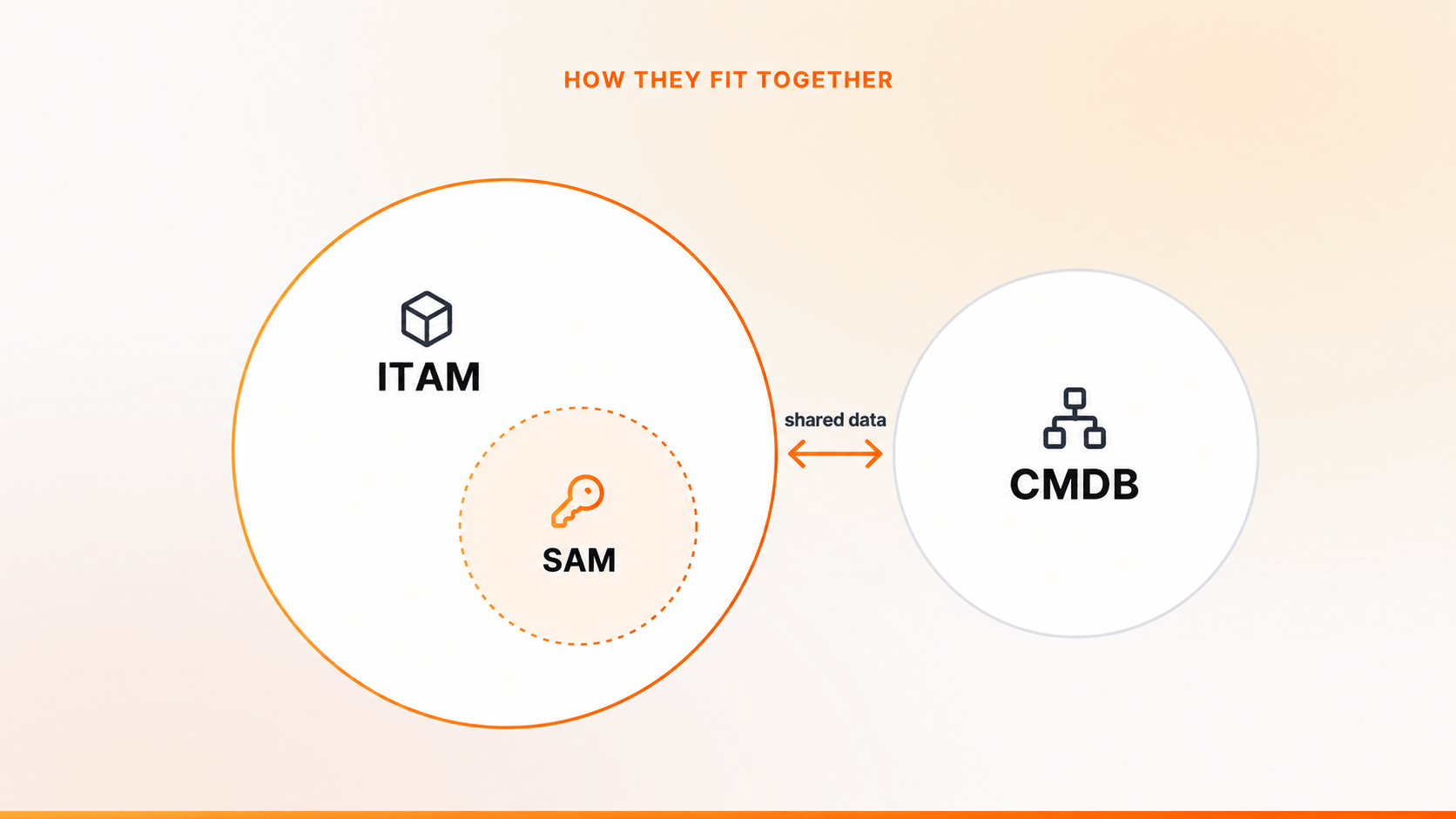
| Category | Scope | Main goal |
|---|---|---|
| SAM (software asset management) | Software licenses and usage | License compliance and cost control |
| ITAM | All IT assets, including hardware, software, and cloud | Lifecycle and cost management |
| CMDB | Configuration items and relationships | Service impact and change control |
SAM is a subset of ITAM. The CMDB sits beside ITAM, sharing data rather than containing it.
Is ServiceNow an ITAM or a CMDB?
Both. ServiceNow offers a CMDB as part of its core platform and sells IT asset management separately, covering hardware, software, and cloud assets. Its ITAM products connect to the CMDB, so the two share data on one platform.
Having a ServiceNow CMDB doesn’t mean you have ITAM. Check which modules your license actually includes.
What are the three C’s of CMDB?
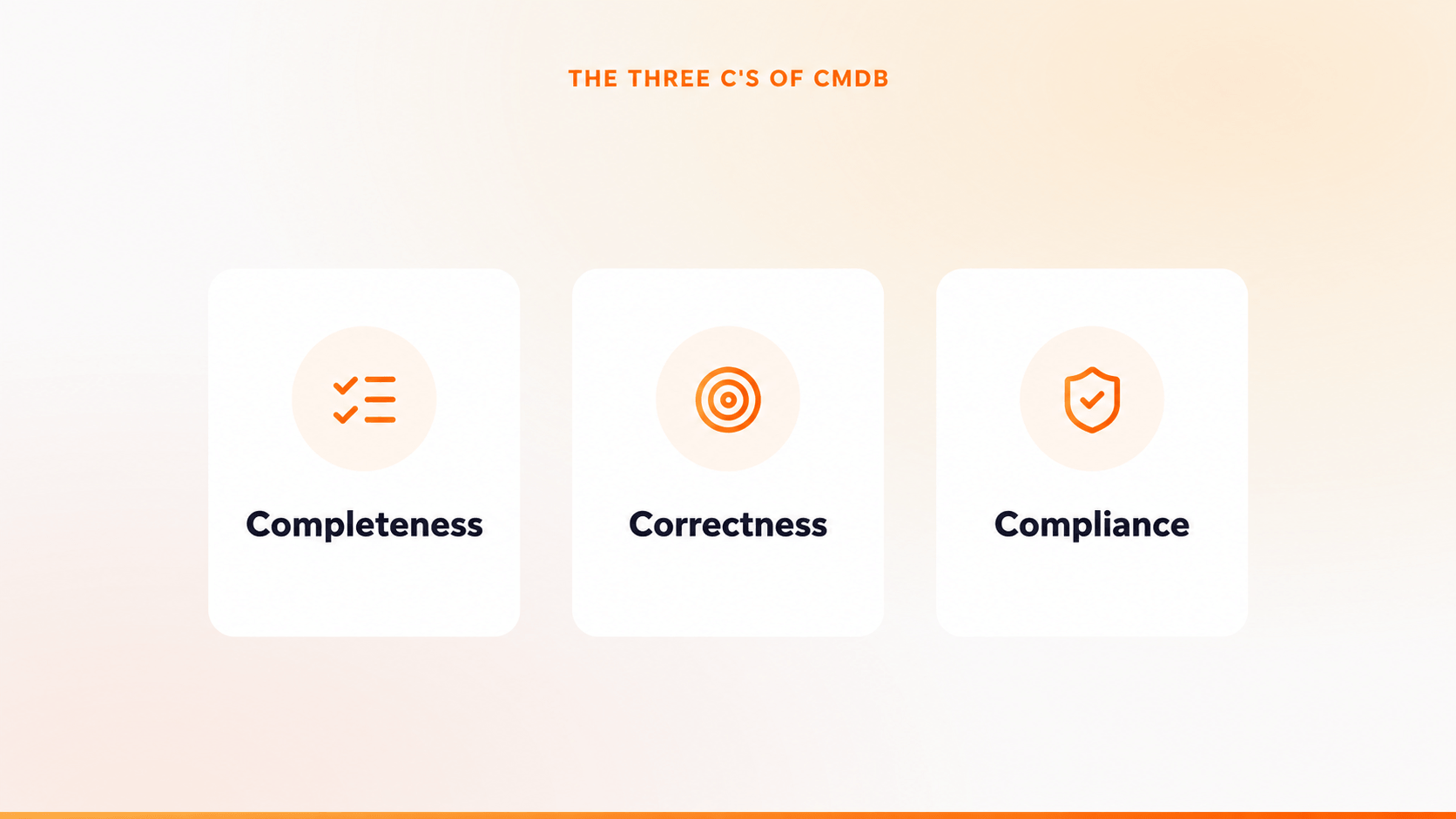
The three C’s are completeness, correctness, and compliance.
- Completeness: Are the required CI fields and relationships filled in?
- Correctness: Is the data accurate, without duplicates or orphaned CIs?
- Compliance: Do CIs match the expected configuration and audit standards?
Who owns which data?
Most CMDB and ITAM projects stall over ownership, not technology. Assign one owner and one source system per field.
| Data | Owning team | Source of truth |
|---|---|---|
| Purchase price and PO | Procurement | Procurement or ERP system |
| Depreciation and cost center | Finance | ERP |
| Assigned user and start/end dates | HR | HRIS |
| OS, apps, and security status | IT operations | MDM (Jamf, Iru, Microsoft Intune) |
| Relationships and dependencies | IT operations | CMDB and discovery |
| Physical location and shipping status | IT asset management | Lifecycle platform |
| Disposal and data destruction | IT asset management | ITAD certificates |
To keep both systems in sync, match records on a shared identifier such as serial number, let each field’s source of truth win in a conflict, and trigger updates from HRIS events like onboarding and offboarding.
Your CMDB knows the device exists. Who knows where it is?
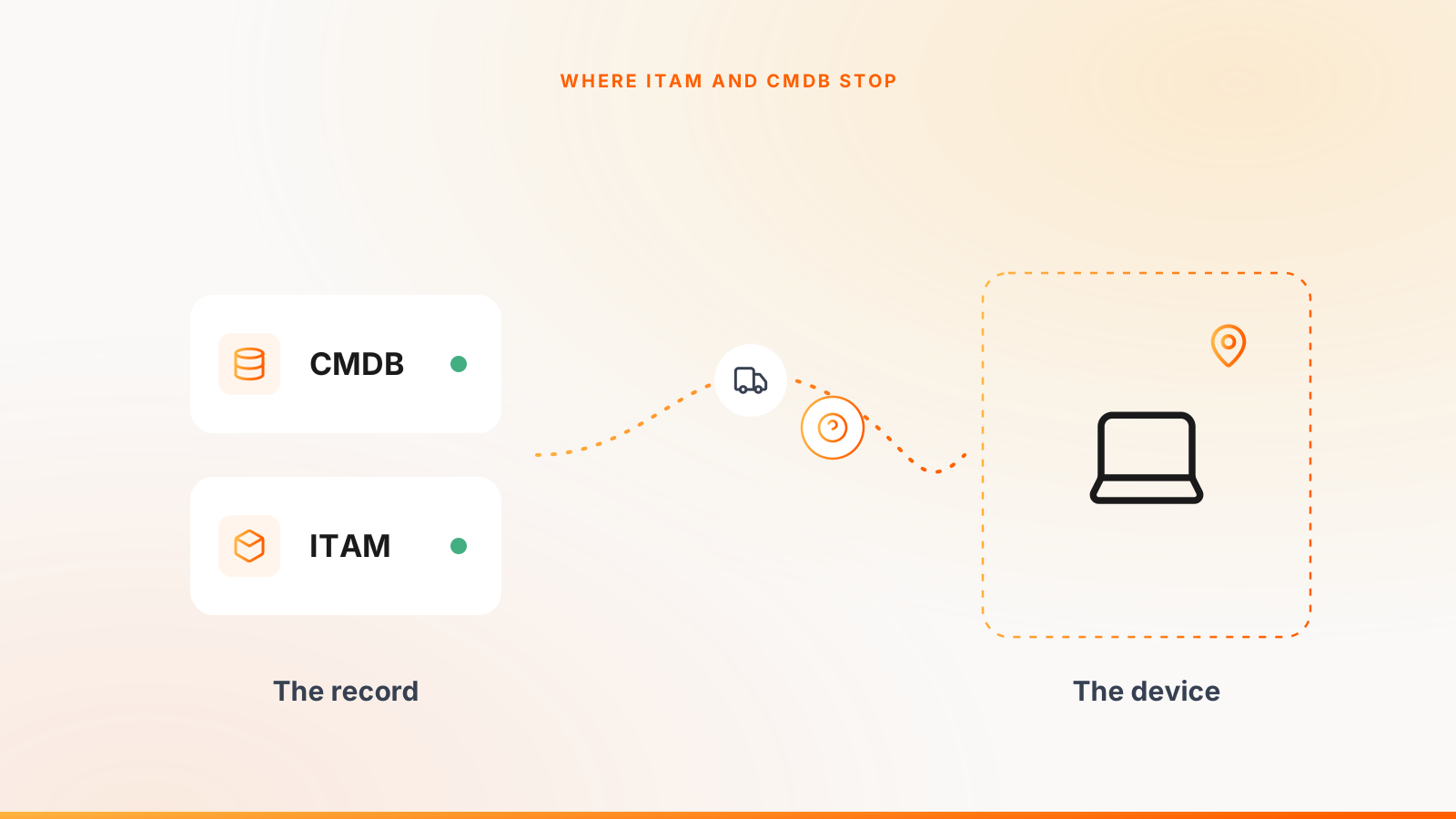
Here’s the gap no comparison table shows. ITAM and the CMDB both stop at the database record. For distributed teams, the hard part happens outside it: shipping a laptop to a new hire, swapping a broken one, and getting a device back from someone who left three weeks ago.
When that physical layer is manual, both systems drift. The CMDB still lists a device as active. ITAM still shows it assigned to a former employee. And the data on it is still unwiped.
Unduit is built for that layer. It’s an ITSM-native platform that connects each ticket to the device behind it, from procurement and deployment through recovery and retirement:
- Automated pickup scheduling: sends reminders and arranges device pickups without manual follow-up
- Real-time tracking dashboard: monitors laptops, monitors, and peripherals in transit from anywhere
- Smart inventory updates: logs returned devices, records condition, and updates your asset records
- Refurbish and redeploy recommendations: suggests repair, upgrade, or redeployment options to maximize asset value
- Secure chain of custody: logs every step for compliance and data security
- Global support: handles domestic and international shipments
- Employee-friendly communication: sends timely updates by email, text, or call
FAQs
What is the main difference between a CMDB and ITAM?
ITAM tracks what you own and what it costs across its lifecycle. A CMDB tracks how IT components are configured and connected, and what’s affected when one changes.
Does a CMDB store financial data?
It can, but it isn’t designed to. Cost, contract, and depreciation data is better managed in ITAM, with the CMDB referencing it.
What’s the difference between a configuration item and an IT asset?
An asset is something with financial value you own and manage over its lifecycle. A CI is any component that must be managed to deliver a service. Many items are both.
Do mid-sized companies need a CMDB?
Not always a full one. Most benefit from a scoped CMDB covering critical services, built on top of an accurate asset inventory.
How do ITAM and CMDB handle remote employees’ devices?
Poorly, on their own. Both depend on someone updating records when devices ship, move, or come back. Automated recovery and HRIS triggers close that gap.
Is ServiceNow considered a CMDB?
ServiceNow includes a CMDB in its core platform. ITAM is a separate set of products that connects to it.
Disclosure: This article is published by Unduit, which provides device lifecycle and ITSM software. We’ve aimed to describe ServiceNow and other tools accurately and neutrally.