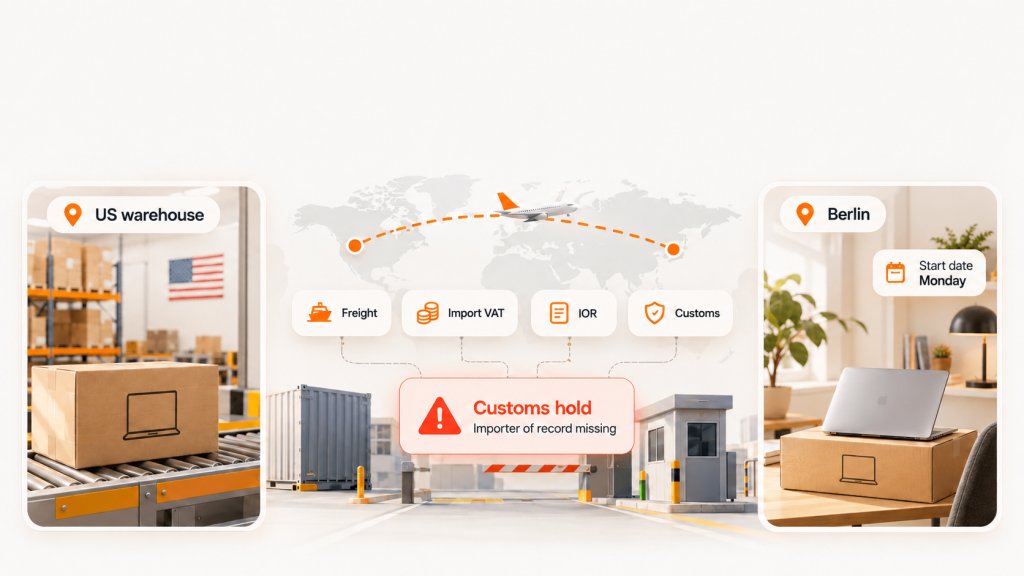
A new engineer in Berlin starts Monday. Her laptop left a US warehouse ten days ago and is sitting at German customs because nobody named an importer of record. She spends her first week on a borrowed machine.
That’s the international procurement process in practice. Buying the device is easy. Clearing, delivering and recording it in another country is where IT teams lose time and money.
TL;DR
- International procurement is buying goods from suppliers in another country, or delivering them across borders.
- For IT teams, it runs in eight steps, from defining the device spec to matching the invoice.
- Biggest cost trap: the unit price. In our example, import VAT, freight and fees add about a third.
- Most-skipped step: getting devices back across borders.
What is international procurement?
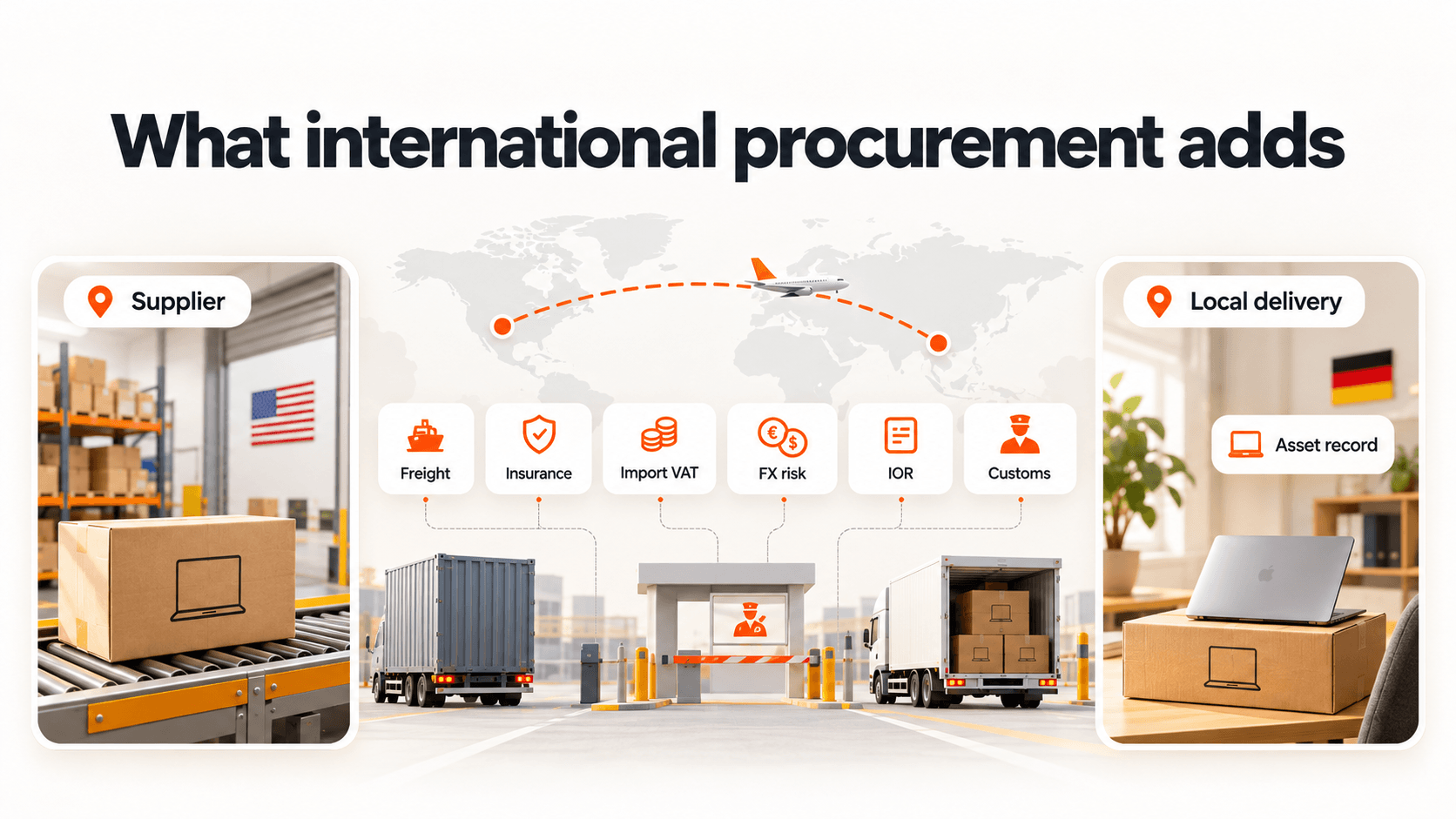
International procurement is the process of sourcing, buying and importing goods or services from suppliers in another country. It adds customs, import taxes, trade terms, currency risk and export compliance to a standard purchasing workflow.
Global procurement is the company-wide strategy; international sourcing, or overseas sourcing, is finding foreign suppliers. For IT teams, it means global IT procurement: getting laptops to employees in many countries.
Domestic vs international procurement: what changes?
| Area | Domestic | International |
|---|---|---|
| Cost | Unit price, shipping, sales tax | Adds freight, insurance, import VAT/GST, broker fees and FX |
| Legal | One jurisdiction | Importer of record, local tax rules, export controls |
| Configuration | One keyboard layout and plug | Local layouts and power standards |
| Payment | USD, standard terms | Multiple currencies and exchange-rate risk |
| Returns | Prepaid label | Cross-border paperwork and possible duty |
The 8-step international IT procurement process
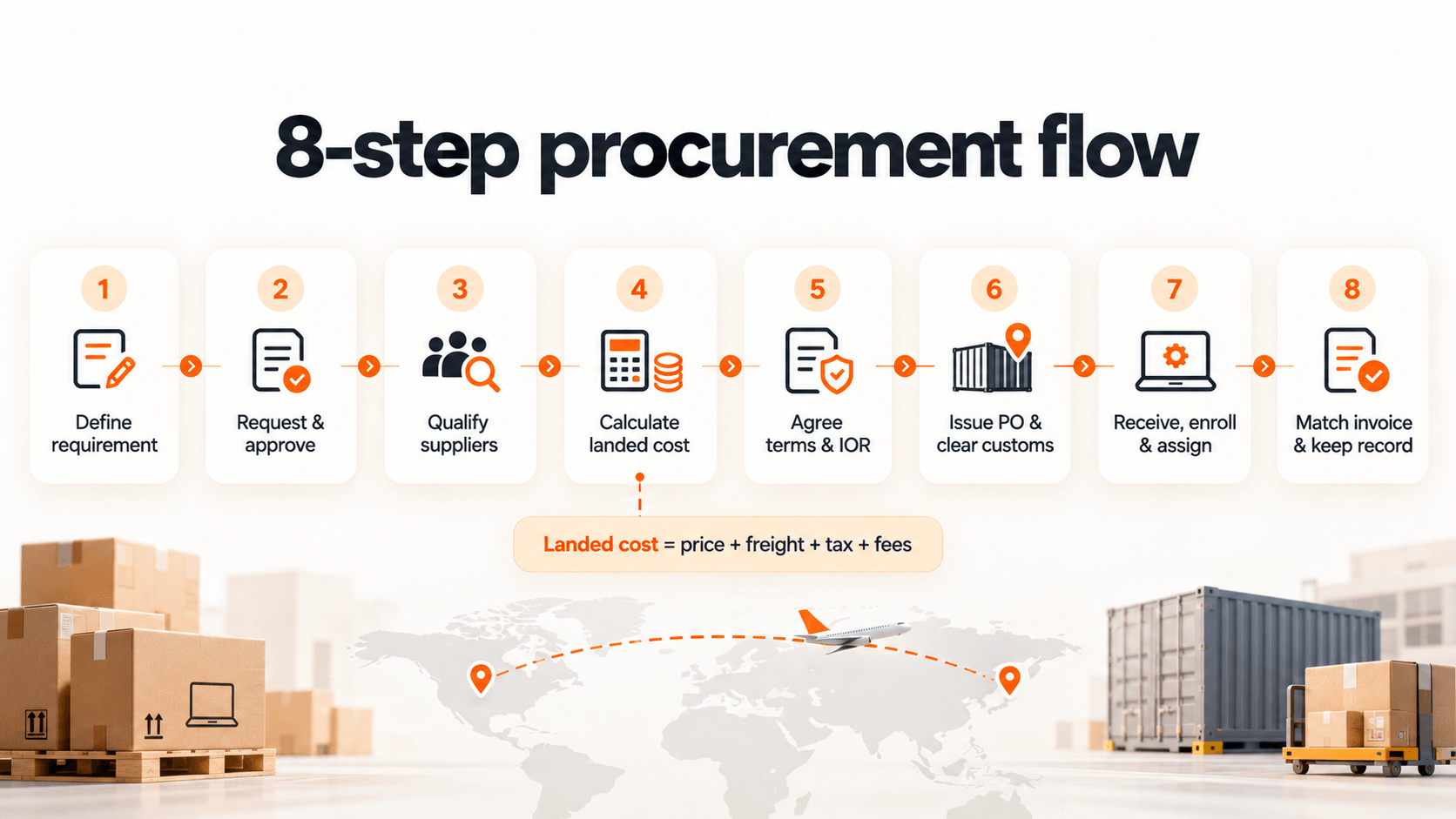
1. Define the requirement
Specify the model, configuration, keyboard layout, power adapter, destination and a needed-by date tied to the hire’s start date. A US-layout keyboard shipped to a French employee is a reorder.
2. Raise the request and get approval
Start with a service catalog ticket in your ITSM tool. An approval workflow routes it to the budget owner, and the ticket becomes the audit trail linked to the asset record.
3. Qualify suppliers by country
Ask each supplier for recent delivery times and SLAs per country, not a coverage map. Confirm local stock, in-country warranty and whether they can act as importer of record.
4. Calculate the landed cost
Landed cost = unit price + freight + insurance + duty + import VAT or GST + broker or IOR fees + FX impact.
Laptops (HS 8471.30) carry 0% duty in the US, UK, EU and India under the WTO Information Technology Agreement. Import tax, not duty, moves the number.
| Cost line (one $1,400 laptop shipped from the US) | UK | Germany | India |
|---|---|---|---|
| Unit price | $1,400 | $1,400 | $1,400 |
| Freight and insurance (est.) | $120 | $120 | $120 |
| Customs duty | $0 | $0 | $0 |
| Import VAT / GST | $304 (20%) | $288.80 (19%) | $273.60 (18% IGST) |
| Broker or IOR fee (est.) | $80 | $80 | $80 |
| Landed cost | $1,904 | $1,888.80 | $1,873.60 |
Illustrative figures, excluding FX. Rates: UK VAT, India duty and IGST on HS 84713010.
Import VAT is usually recoverable only when a VAT- or GST-registered local entity is the importer. Without one, that tax often becomes a sunk cost.
5. Agree Incoterms, importer of record and payment terms
Incoterms 2020 define who pays for and carries risk on each leg of the shipment.
| Incoterm | Seller handles | Buyer handles | When it fits IT teams |
|---|---|---|---|
| EXW | Makes goods available at its site | Everything else, including export | Rarely; you become the exporter |
| FCA | Export clearance, handover to your carrier | Main freight, import, duties | You use your own freight forwarder |
| DAP | Delivery to the named address | Import clearance, duty, VAT | You have a local entity or IOR |
| DDP | Everything, including import duty and VAT | Unloading | Home delivery where you have no entity |
The importer of record (IOR) is legally responsible for the import. If you use an employer of record, confirm in writing whether it covers equipment imports. Then lock payment terms and who absorbs FX swings.
6. Issue the PO, clear customs and track
The purchase order should state the HS code, Incoterm and delivery address. The commercial invoice and packing list must match it exactly, since mismatches are a common cause of customs holds. Track every shipment by serial number.
7. Receive, inspect, enroll and assign
Check the serial number, condition and configuration on arrival. Enroll the device in your MDM (Microsoft Intune, Jamf or Kandji) through Apple Business Manager or Windows Autopilot, tag it and assign it to the employee in your asset records.
8. Match, pay and keep the record
Run a three-way match across the PO, receiving record and invoice before payment. Keep customs entries, VAT invoices and delivery proof for audits.
The step nobody writes about: getting devices back across borders
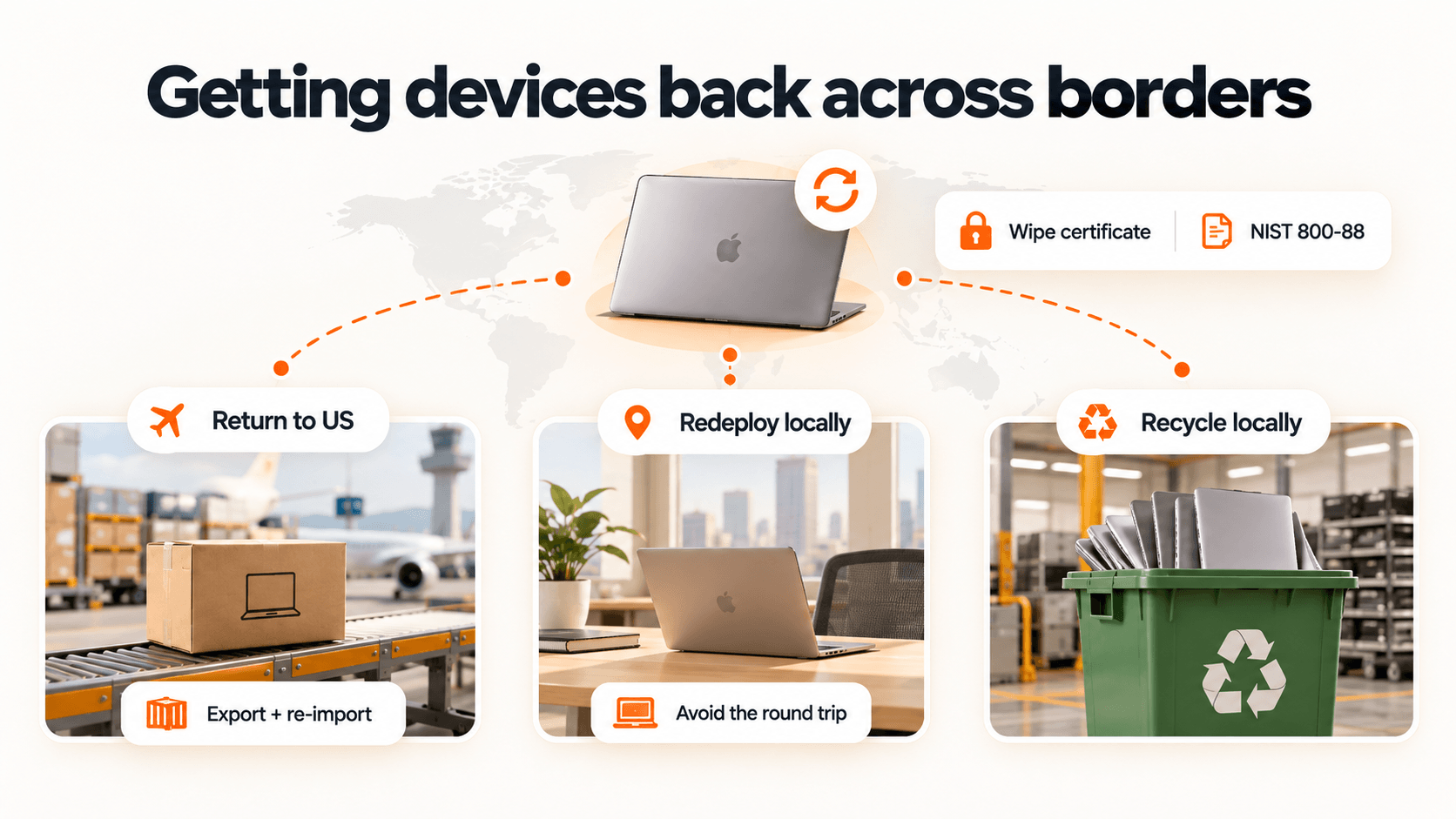
Most guides end at “pay the supplier.” When an employee abroad leaves, the laptop still has to be recovered, wiped and returned, redeployed or recycled.
- Returning to the US is an export from one country and an import into another. US goods returned unchanged may qualify for duty-free entry under HTSUS 9801.00.10, but only with proper documentation.
- Redeploying or recycling in-country often avoids the round trip entirely.
- Data destruction should follow NIST SP 800-88, with a certificate for every device.
| Model | Works well when | Trade-off |
|---|---|---|
| Buy locally per country | A few countries with large headcount in each | Many suppliers, invoices and inconsistent specs |
| US hub that exports | You need strict standard images | You own export, IOR, VAT and customs delays |
| Managed global provider | Many countries with small headcount in each | Vendor dependency; confirm country coverage in the contract |
FAQs
What are the 7 steps of the procurement process?
Identify the need, raise a requisition, select suppliers, negotiate terms, issue the PO, receive and inspect goods, then match the invoice and pay. International procurement adds landed cost, Incoterms and customs.
What are the four main types of procurement?
Direct (goods that go into your product), indirect (goods that run the business, such as laptops), goods and services.
Which Incoterm is best for shipping laptops to remote employees?
DDP is usually simplest for home delivery, because the seller or its IOR handles import duty and VAT. Use DAP when you have a local entity that can import and reclaim VAT.
Do I need a local entity to ship IT equipment to another country?
Not always, but someone must act as importer of record. Without an entity, use an IOR service or a provider that acts as one.
How do you get company devices back from employees abroad?
Arrange a local pickup, document the export and re-import, and wipe the device to NIST 800-88. Redeploying or recycling in-country is often cheaper.