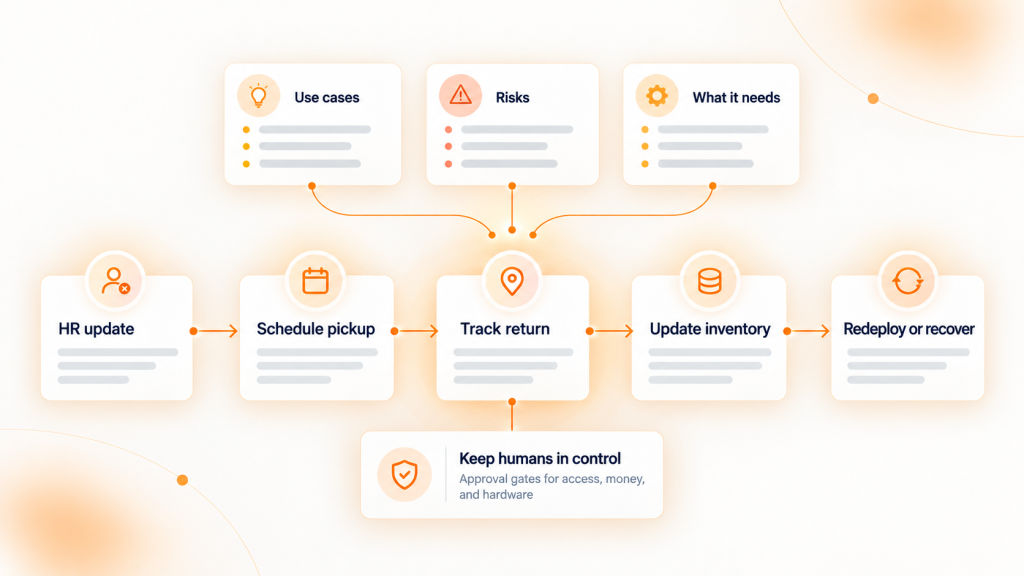
The SOC 2 auditor’s first request is rarely about firewalls. It’s a list of every device that touches customer data, who has it and how you know. Most IT teams can produce the list. Fewer can prove it’s accurate.
That gap is why an IT compliance strategy has to start with what you own, not with which framework to buy a tool for.
TL;DR
- An IT compliance strategy is a plan for meeting regulatory and framework requirements with defined owners, controls, evidence and timelines.
- Every major framework requires an asset inventory, so compliance breaks wherever device records break.
- Build it in six phases: scope, inventory, assess, map, implement and monitor.
- Map one control to many frameworks to avoid doing the same work twice.
- Offboarding and device disposal are the most common gaps for distributed teams.
What is an IT compliance strategy?
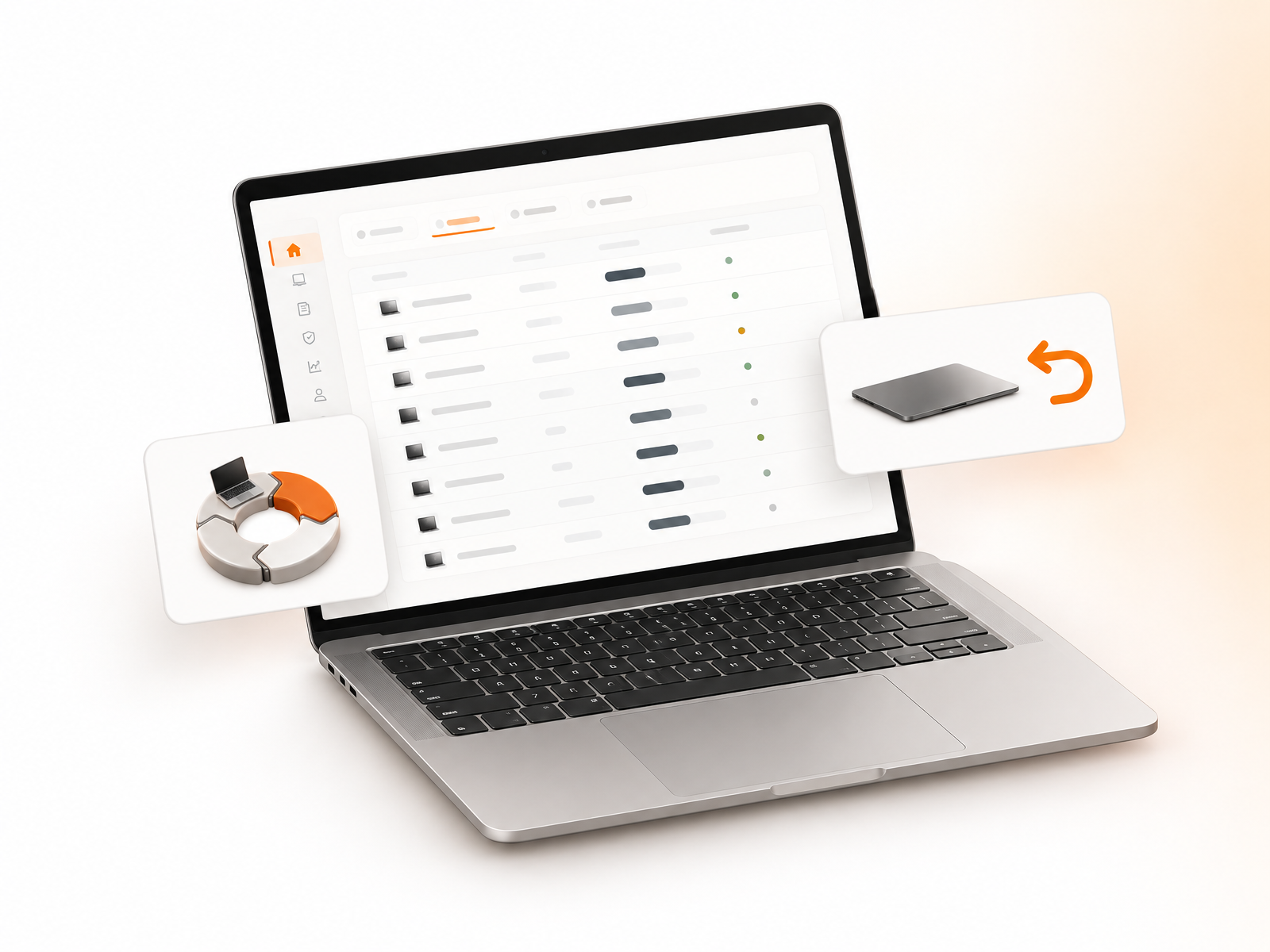
An IT compliance strategy is a documented plan for how an organization meets the laws, regulations and frameworks that govern its technology and data. It defines which rules apply, which controls satisfy them, who owns each control and how evidence is collected, so compliance becomes routine work instead of an annual scramble.
IT compliance vs. IT security
| Category | IT compliance | IT security |
|---|---|---|
| Goal | Prove you meet external requirements | Protect systems and data from threats |
| Driven by | Regulators, auditors, customers | Risk and threat landscape |
| Output | Evidence, reports, attestations | Controls, monitoring, response |
| Success looks like | A clean audit | Fewer and smaller incidents |
Strong security doesn’t guarantee compliance, and passing an audit doesn’t make you secure. A good strategy connects the two.
Why most IT compliance strategies fail
The frameworks are rarely the problem. Execution is.
- Evidence lives in spreadsheets. Teams rebuild proof by hand before every audit.
- Frameworks overlap. SOC 2, ISO 27001 and HIPAA ask for similar controls, and teams document each one separately.
- Remote devices go dark. Laptops in transit, in storage or with former employees stop checking in, and their records freeze.
- Nobody owns the handoffs. HR closes the offboarding, IT revokes access, and the laptop is never collected.
The stakes are real. The average US data breach cost $10.22 million in 2025, according to IBM’s Cost of a Data Breach Report.
Start with what you own: asset management compliance
You can’t protect, patch or wipe a device you don’t know exists. That’s why asset inventory shows up in nearly every framework:
- ISO/IEC 27001:2022 Annex A 5.9 requires an inventory of information and associated assets.
- SOC 2 CC6.1 includes identifying and managing the inventory of information assets as a point of focus.
- NIST CSF 2.0 opens its Identify function with asset management (ID.AM).
- PCI DSS 4.0.1 Requirement 12.5.1 requires an inventory of in-scope system components.
For distributed teams, asset management compliance extends past the inventory itself. It covers license compliance, device recovery at offboarding and certified data destruction at end of life. NIST SP 800-88 Rev. 2, published in September 2025, now frames sanitization as an enterprise program rather than a one-off technical task.
How to build an IT compliance strategy in 6 phases
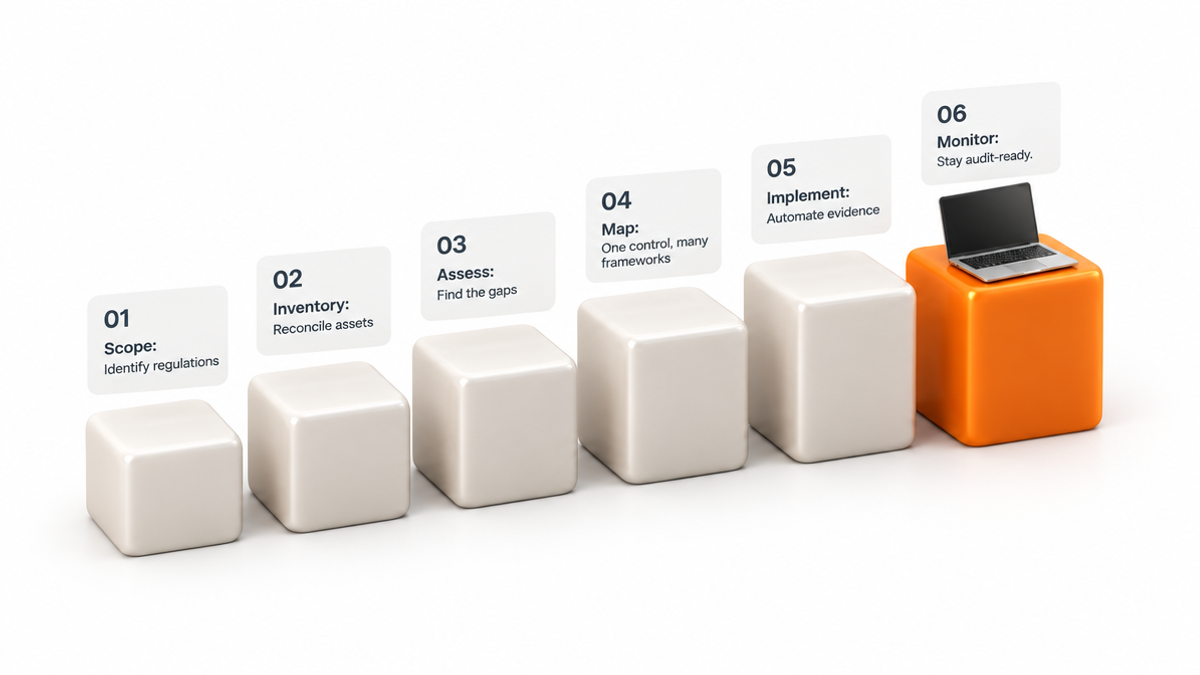
Phase 1: Identify applicable regulations and frameworks
List every obligation by data type, industry, customer contract and location. A SaaS company selling to healthcare may need SOC 2, HIPAA and state privacy laws at once.
Phase 2: Inventory assets and data
Reconcile MDM, procurement, finance and HRIS records into one asset list. Flag devices assigned to departed employees first, since they’re the highest-risk gap.
Phase 3: Run a risk and gap assessment
Compare current controls against requirements and rank gaps by likelihood and impact. The output is a risk register your leadership can act on.
Phase 4: Map controls and write policies
Build one control matrix across all frameworks. Write policies people can follow, including access reviews, offboarding and device disposal.
Phase 5: Implement, automate and train
Automate evidence wherever a system already records the event, such as access removal, patch status or device returns. Train employees on the policies that depend on them.
Phase 6: Monitor, audit and improve
Track KPIs monthly, run internal audits before external ones and update controls when regulations change.
| Phase | Typical owner | Illustrative timeline | Output |
|---|---|---|---|
| 1. Scope | Legal, CIO | Weeks 1–2 | Obligations register |
| 2. Inventory | IT operations, ITAM | Weeks 2–6 | Reconciled asset and data inventory |
| 3. Assess | Security | Weeks 5–8 | Risk register and gap list |
| 4. Map | Security, IT | Weeks 8–12 | Control matrix and policies |
| 5. Implement | IT, HR, Security | Months 3–6 | Automated controls and evidence |
| 6. Monitor | Compliance, Security | Ongoing | Audit-ready evidence and dashboards |
One control, many frameworks
Mapping each control once saves weeks of duplicated documentation.
| Control | ISO 27001:2022 | SOC 2 | NIST CSF 2.0 | PCI DSS 4.0.1 | HIPAA Security Rule |
|---|---|---|---|---|---|
| Asset inventory | A.5.9 | CC6.1 | ID.AM-01, ID.AM-02 | 12.5.1 | 164.310(d)(2)(iii) |
| Offboarding: access removal and asset return | A.5.11, A.5.18 | CC6.2, CC6.3 | PR.AA-05 | 8.2.5 | 164.308(a)(3)(ii)(C) |
| Secure disposal | A.7.14 | CC6.5 | ID.AM-08 | 9.4.7 | 164.310(d)(2)(i) |
| Incident response | A.5.24–A.5.26 | CC7.3–CC7.5 | RS.MA | 12.10.1 | 164.308(a)(6) |
Confirm control IDs against current framework versions with your auditor.
IT compliance strategy example
A 1,200-person remote software company needs a SOC 2 Type 2 report to close an enterprise deal. Finance has paid for 1,350 laptops. MDM shows 1,290 enrolled, and 38 of those are still assigned to people who left.
Instead of starting with policies, the team:
- Reconciles MDM, purchase and HRIS records into one inventory
- Recovers or writes off the 60 untracked devices
- Ties HRIS terminations to same-day access removal and a recovery request
- Attaches a wipe certificate to every retired device record
When the audit window opens, the asset list, offboarding evidence and disposal records already match.
IT compliance KPIs to track
| KPI | Suggested starting target |
|---|---|
| Assets reconciled across MDM, finance and HRIS | 100% |
| Access revoked on the last working day | 100% |
| Devices recovered within 30 days of departure | 95%+ |
| Retired devices with a sanitization certificate | 100% |
| Evidence collected automatically vs. manually | Increasing quarter over quarter |
Targets are suggested starting points, not published benchmarks.
Regulations to watch in 2026
| Regulation | What’s changed | Who should care |
|---|---|---|
| PCI DSS 4.0.1 | Future-dated requirements became mandatory on March 31, 2025 | Anyone handling card data |
| CCPA cybersecurity audits | Regulations took effect January 1, 2026; first certifications are due April 1, 2028, for businesses over $100 million in revenue | Businesses subject to the CCPA |
| NIST SP 800-88 Rev. 2 | Sanitization guidance replaced Rev. 1 in September 2025 | Every team retiring devices |
| EU AI Act | The Digital Omnibus moved most high-risk deadlines to December 2, 2027 | US companies with EU operations or customers |
IT compliance checklist
- List every regulation and framework in scope
- Reconcile one asset inventory across MDM, finance and HRIS
- Assign an owner to every control
- Map controls across frameworks in one matrix
- Revoke access on the last working day
- Recover every company device at offboarding
- Sanitize retired devices and keep certificates
- Review access quarterly
- Track compliance KPIs monthly
- Run an internal audit before every external one
General guidance, not legal advice. Confirm requirements with counsel and your auditor.
Revoked Access Means Nothing If the Laptop Never Comes Back

Disabling an account takes minutes. Getting the laptop back from a former employee three states away can take months, and until it arrives, your audit evidence has a hole in it.
Unduit closes that gap by connecting the physical device lifecycle to your service desk and asset records, from procurement and deployment through recovery and retirement, across 100+ countries. Its AI-powered IT agent automates the follow-up while you keep full control:
- Automated pickup scheduling: sends reminders and arranges device pickups without manual follow-up.
- Real-time tracking dashboard: monitors laptops, monitors and peripherals in transit from anywhere.
- Smart inventory updates: logs returned devices, records their condition and syncs with your asset management system.
- Refurbish and redeploy recommendations: suggests repair, upgrade or redeployment options to maximize asset value.
- Secure chain of custody: logs every step for audits, with R2-certified recycling at end of life.
- Global support: handles domestic and international shipments to reduce delays.
- Employee-friendly communication: keeps departing employees updated by email, text or phone.
FAQs
What is an example of IT compliance?
Revoking a departing employee’s access on their last day and keeping a record of it. That single control satisfies requirements in SOC 2, ISO 27001, PCI DSS and HIPAA.
What are the 5 key areas of IT compliance?
Common groupings are asset management, access control, data protection, incident response and vendor risk management. Exact categories vary by framework.
What are the top 5 compliance regulations for US IT teams?
HIPAA, SOX, PCI DSS, the CCPA and, for companies serving EU residents, GDPR. SOC 2 and ISO 27001 are frameworks rather than laws, but customers often require them.
What is the difference between IT compliance and an IT audit?
IT compliance is the ongoing work of meeting requirements. An IT audit is a point-in-time review that tests whether that work is effective and documented.
Why does IT asset management matter for compliance?
Most frameworks require an accurate asset inventory, and controls like patching, encryption and data destruction depend on it. Inaccurate asset records weaken every control built on them.