Your service desk handled 300 employees without much strain. At 1,500 people spread across a dozen states, ticket queues grow faster than headcount, asset records drift out of date, and approvals stall in someone’s inbox.
That is usually when the shortlist narrows to two names: Freshservice and ServiceNow.
TL; DR
- Freshservice fits mid-market IT teams that want to go live in weeks with pricing they can see upfront.
- ServiceNow fits large enterprises that need deep CMDB capabilities, heavy customization, and a platform team to run it.
- Neither one moves a physical device, so plan for lifecycle operations separately.
Both are mature, ITIL-aligned platforms. They are also built for different organizations, priced differently, and demand very different levels of admin effort. This guide compares them on the factors that actually decide the contract, then covers the part of IT operations that neither tool handles.
Freshservice vs ServiceNow at a Glance
Sources: G2, Freshworks pricing
Where Freshservice wins
Faster setup and easier adoption
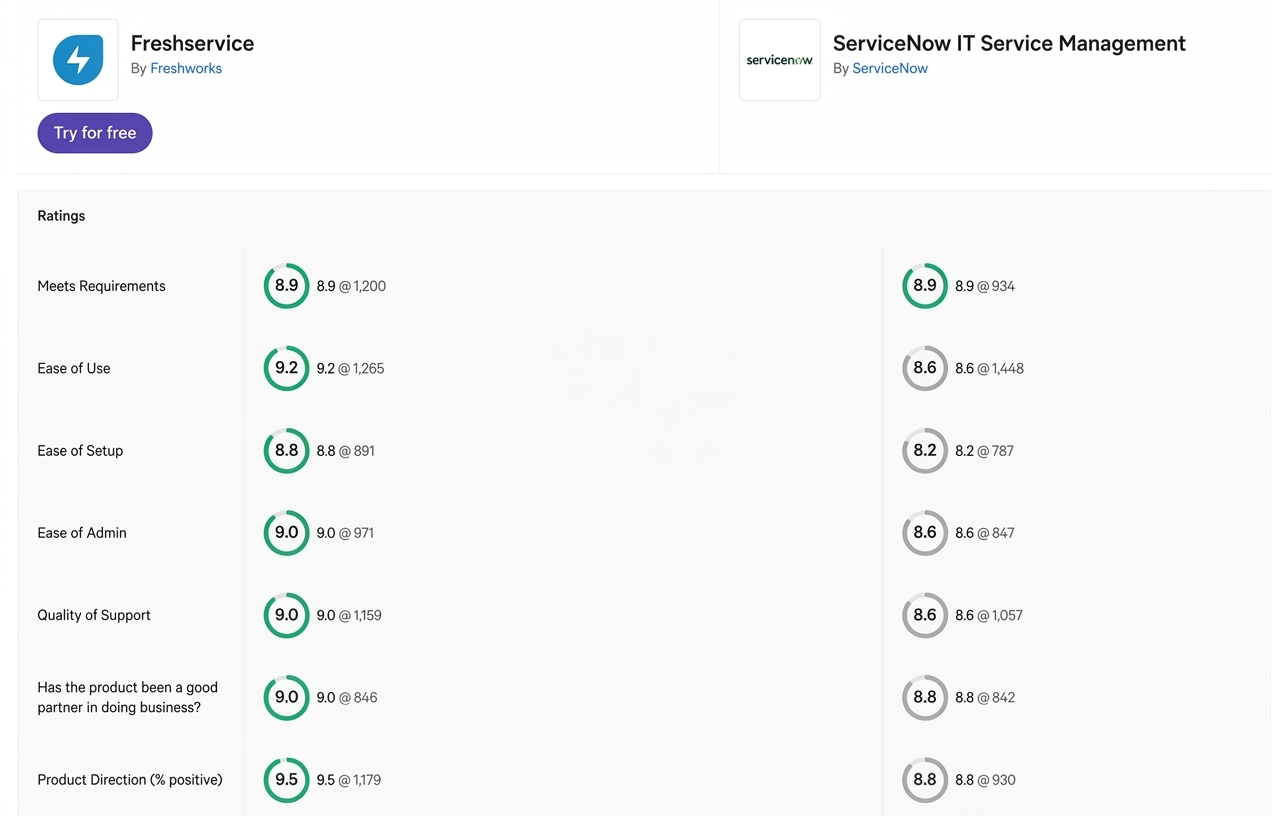
Freshservice consistently scores higher with the people who use it every day. On G2, Freshservice scores 9.2 for Ease of Use against ServiceNow’s 8.5, and 8.8 versus 8.1 for Ease of Setup.
For a 10-person IT team without a dedicated platform admin, that gap matters. New agents can work tickets within days, and workflow changes don’t require a consultant.
Pricing you can see before you sign
Freshservice publishes its rates. Annual pricing runs $19 per agent per month for Starter, $49 for Growth and $99 for Pro, with Enterprise quoted separately. Employees who submit tickets are not licensed, so costs scale with your IT staff rather than your total headcount.
Workflow depth and CMDB
ServiceNow is a workflow platform first and a service desk second. Its CMDB maps assets, services and the dependencies between them, which matters when a single change can affect dozens of business applications.
If your change advisory board needs impact analysis before approving a server patch, ServiceNow handles that natively.
One platform beyond IT
ServiceNow extends into HR service delivery, security operations and customer service on a shared data model. A global company can run onboarding across IT, HR and facilities in one orchestrated workflow instead of stitching tools together.
The trade-off is maintenance. Most ServiceNow customers staff at least one dedicated administrator to keep the platform healthy.
What each platform costs in 2026
Freshservice
- Starter ($19): incident management, knowledge base, self-service portal
- Growth ($49): adds asset management and a service catalog
- Pro ($99): adds problem, change and release management
- Enterprise: custom quote
Watch the tier gates. Change management, problem management, major incident management and release management all sit at the Pro tier, and teams that budget for Growth often discover this late. Freddy AI Copilot adds $29 per agent per month on annual billing.
ServiceNow
ServiceNow publishes no list prices. In April 2026, it replaced its five legacy ITSM tiers with three new ones called Foundation, Advanced and Prime, each bundling AI features by default.
Third-party analysts estimate fulfiller licenses at $70 to $200 per user per month and implementation at $30,000 to $150,000 or more. ServiceNow also charges for business stakeholder seats, meaning managers who approve requests without working tickets.
Streamline IT Service Management with Unduit
Automate requests, manage assets, and deliver better IT support from one platform.
Get demoFreshservice vs ServiceNow pricing
**ServiceNow does not publish pricing, so every figure requires a quote.
Which one should you choose?
Before signing either contract, ask three questions:
- Which of our must-have processes sit above the entry tier?
- Who will administer the platform in year two?
- What does renewal look like after the first-term discount ends?
What happens to the device after the ticket closes?
Here is a scenario both platforms handle only halfway.
A remote engineer in Denver resigns on Friday. HR triggers offboarding, and your ITSM opens tasks to revoke access, recover the laptop and update the asset record.
Access is revoked within minutes. The laptop is a different story. Someone emails a return label, follows up twice, and the box arrives three weeks later without the charger. An analyst updates the record by hand and then decides whether to wipe, redeploy or recycle the device.
The ticket closed on day one. The device took a month.
Freshservice and ServiceNow are systems of record, and both track assets well as data. Neither one physically handles:
- Procuring and configuring devices for new hires
- Shipping equipment to remote employees
- Recovering devices from departing staff
- Repairing or replacing damaged hardware
- Wiping data and disposing of retired devices with certified chain of custody
At a few offboardings a month, this is a nuisance. At dozens a month across multiple states, it becomes lost devices, audit gaps and an IT team stuck firefighting logistics. For more detail, see our guide to remote employee equipment returns.
Your ITSM runs the ticket. Unduit runs the device.
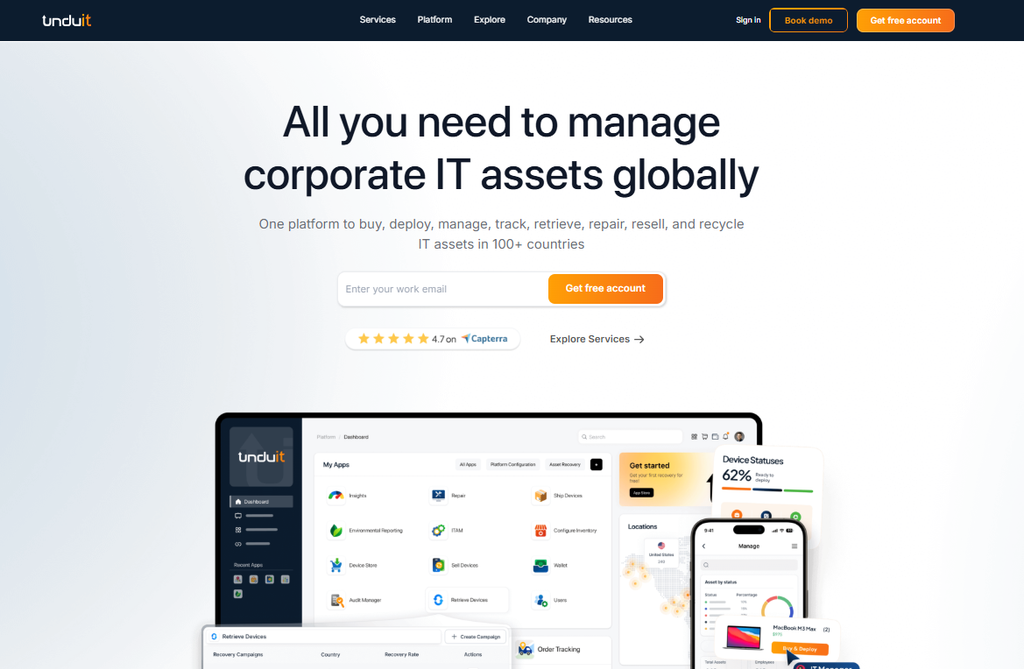
Choose Freshservice or ServiceNow based on what your service desk needs. Unduit handles the physical side of the IT asset lifecycle across 100+ countries, so devices move as reliably as tickets do.
Unduit’s AI-powered IT agent automates the manual coordination while keeping you in control:
- Automated pickup scheduling: sends reminders and arranges device pickups without manual follow-up.
- Real-time tracking dashboard: shows every laptop, monitor and peripheral in transit, from anywhere.
- Smart inventory updates: logs returned devices, records their condition, and integrates with your asset management system.
- Refurbish and redeploy recommendations: suggests repair, upgrade or redeployment options to maximize asset value.
- Secure chain of custody: logs every step so it is auditable for compliance and data security.
- R2 Certified ITAD: provides secure, sustainable disposal when a device reaches end of life.
- Global support: handles domestic and international shipments to reduce delays.
- Employee-friendly communication: keeps departing and new employees updated by email, text or call.
For teams that want service management and device operations in one place, Unduit also offers its own ITSM. Unduit holds a 4.85 rating on Capterra and is ISO 27001 certified.
FAQs
Q1: Is Freshservice cheaper than ServiceNow?
Yes, in most mid-market scenarios. Freshservice publishes per-agent pricing starting at $19 per month. ServiceNow is quote-only, and third-party estimates put its licensing plus implementation well above Freshservice at comparable agent counts.
Q2: Can Freshservice replace ServiceNow for enterprise use?
It can for enterprises with standard ITSM needs. Organizations that depend on deep CMDB dependency mapping, heavy customization or cross-department orchestration usually stay on ServiceNow.
Q3: How long does each platform take to implement?
Freshservice deployments are typically measured in weeks. ServiceNow implementations often take several months and usually involve a certified partner.
Q4: Does Freshservice include change management?
Only on the Pro tier ($99 per agent per month) and above. Starter and Growth do not include formal change, problem or release management.
Q5: Do ITSM tools handle device shipping and recovery?
No. Freshservice and ServiceNow track assets as records, but physically procuring, shipping, recovering and disposing of devices requires a lifecycle partner such as Unduit.