If you’ve ever bought new laptops, servers, or networking gear for your company, you know how painful the upfront costs can be. Hardware as a Service (HaaS) is changing the game, letting businesses pay monthly instead of sinking huge sums into IT hardware.
The HaaS market is booming, expected to hit $154 billion in 2026 and grow to $525 billion by 2031.
Key Takeaways
- Hardware as a Service (HaaS) helps businesses access IT hardware through affordable monthly subscriptions instead of large upfront investments.
- HaaS providers manage setup, maintenance, upgrades, security, and the complete hardware lifecycle.
- The HaaS model improves scalability, flexibility, and cash flow by converting CapEx into predictable OpEx.
- While HaaS reduces IT management burden, businesses should still evaluate vendor lock-in and data security risks.
What Is Hardware as a Service?
At its core, HaaS means renting hardware instead of buying it outright. You pay a subscription, the provider owns and manages the equipment, and you get to focus on running your business.
- Monthly fee: Covers hardware, setup, maintenance, and upgrades.
- Provider ownership: They handle everything from installation to secure disposal.
- Comparison with other models:
| Model | Delivered | Ownership | Where |
|---|---|---|---|
| HaaS | Physical devices (laptops, servers, networking) | Provider | On-prem |
| IaaS | Virtual servers, VMs | Provider | Cloud |
| PaaS | Dev platform + hardware | Provider | Cloud |
| SaaS | Software applications | Provider | Cloud |
The HaaS Business Model Explained
At its core, the hardware as a service business model revolves around recurring fees for access to hardware. Providers deliver the equipment, manage the setup, and handle the full lifecycle, while customers avoid large upfront capital expenditure.
Ownership Variations
- Provider retains ownership (most common): The customer never owns the hardware.
- Customer takes ownership after installation (rare): Sometimes offered in lease-to-own scenarios.
CapEx → OpEx Transformation
Traditional IT purchases demand a large upfront investment (CapEx), whereas HaaS converts costs into predictable monthly operating expenses (OpEx), improving cash flow and reducing financial risk.
Why HaaS Works
- Customers pay for outcomes, not hardware.
- It mirrors the SaaS model but for physical devices.
- Businesses gain flexibility and predictability, ensuring their IT remains current without disruptive upgrades.
Unlock Seamless Hardware Inventory Management with Unduit.
Discover how IT Teams Across the Globe Use our platform for their Hardware Inventory Management Needs.
Book a Demo!Hardware as a Service Benefits
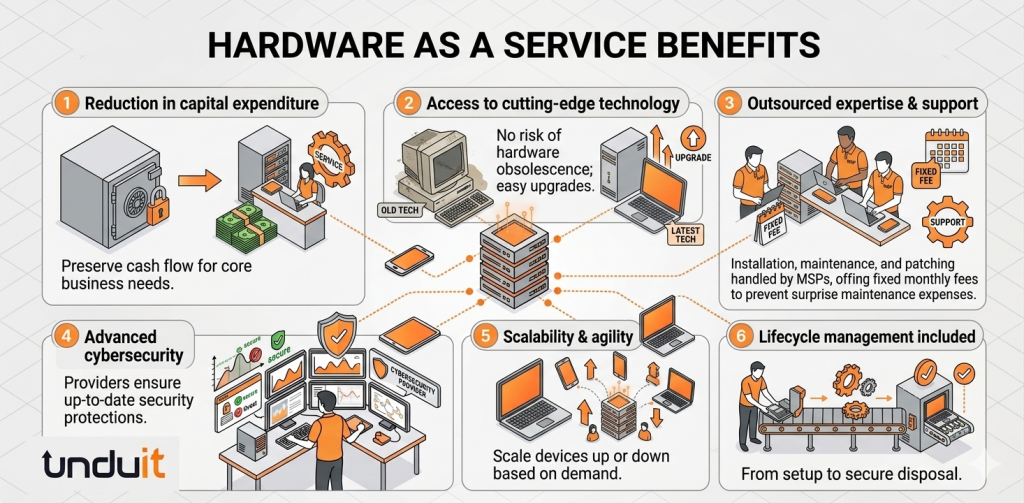
When exploring hardware as a service benefits, it’s easy to see why adoption is growing.
- Reduction in capital expenditure: Preserve cash flow for core business needs.
- Access to cutting-edge technology: No risk of hardware obsolescence; easy upgrades.
- Outsourced expertise & support: Installation, maintenance, and patching handled by MSPs.
- Advanced cybersecurity: Providers ensure up-to-date security protections.
- Scalability & agility: Scale devices up or down based on demand.
- Lifecycle management included: From setup to secure disposal.
- Predictable costs: Fixed monthly fees prevent surprise maintenance expenses.
The combination of financial flexibility and operational simplicity makes HaaS an attractive alternative for businesses of all sizes.
Hardware as a Service Disadvantages
Of course, nothing is perfect. Businesses must understand the concerns about hardware as a service:
- Operational complexity: Coordinating between in-house IT and provider teams can occasionally lead to downtime.
- Data security concerns: Sensitive information is entrusted to third-party providers, especially critical for legal and healthcare sectors.
- Complex sales processes: Long sales cycles, mixed billing models, and contractual nuances.
- Security & compliance issues: Failure to meet regulations can carry steep penalties.
- Limited IT resources: Hardware patching and connectivity issues may arise if providers are under-resourced.
- Vendor lock-in: Moving away from a provider can be costly and time-consuming.
Hardware as a Service Examples by Industry
HaaS isn’t one-size-fits-all. Here’s how different sectors use it:
- Office & Corporate: Laptops, desktops, monitors for onboarding and refresh cycles.
- Retail & Restaurants: POS systems, scanners, card readers for smooth operations.
- Healthcare: Imaging devices, EHR systems, data storage to avoid large upfront costs.
- Field Teams: Rugged tablets, GPS devices for logistics and utilities.
- Remote Work: Webcams, headsets, smart displays for video conferencing.
How to price for hardware as a service:
- Audit your costs and service capacity.
- Benchmark against competitors.
- Gather client feedback.
- Start with a base model, refine later.
- Emphasize value over cost.
Typical contracts span 12–48 months, with setup fees often equal to a single monthly payment. Late payment interest is usually ~10% per month.
How to Manage Hardware as a Service
Businesses and providers need clear management strategies:
- Track devices and lifecycle stages.
- Monitor SLA compliance.
- Plan refresh cycles and security compliance.
- For providers: Inventory systems, automated provisioning, proactive maintenance.
HaaS Agreement: What to Include
A strong hardware as a service agreement should cover:
- Hardware specifications & quantities
- Monthly fees and payment terms
- Setup fees
- Contract duration (24–36 months common)
- Maintenance & support SLAs
- Upgrade and refresh clauses
- Security and data protection responsibilities
- Termination notice and hardware return policies
Unduit: Simplifying Hardware as a Service
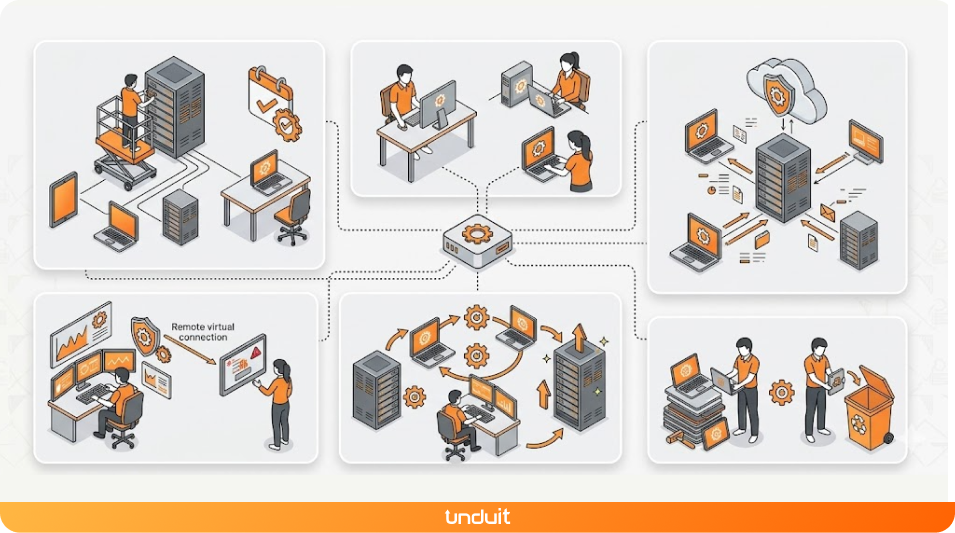
Unduit helps businesses manage their hardware in a simpler and more organized way. Instead of handling devices separately at different stages, it brings everything together from setup to replacement, making day-to-day IT operations easier to track and manage.
- Keeps track of all devices in one place
- Helps reduce manual work in managing IT hardware
- Supports smooth setup, updates, and replacements
- Improves control over equipment usage and movement
- Makes scaling hardware across teams easier
FAQs
What does Hardware as a Service mean for modern business IT operations today?
Hardware as a Service, or HaaS, is a subscription-based IT model where businesses access laptops, servers, networking equipment, and other hardware without purchasing them upfront. Instead of managing procurement, upgrades, maintenance, and disposal internally, organizations rely on providers like Unduit to handle the entire hardware lifecycle while improving scalability, cost control, and operational efficiency.
What is the full form of HaaS in enterprise IT and technology services?
HaaS stands for Hardware as a Service, a modern ITaaS model designed to simplify how organizations deploy and manage technology infrastructure. Rather than investing heavily in owned equipment, businesses pay a predictable monthly fee for fully managed hardware services that often include deployment, technical support, device refreshes, monitoring, and secure asset recovery.
Is Hardware as a Service the same as managed hardware support services?
Managed hardware services are typically a core part of a HaaS solution, but HaaS goes further by combining hardware procurement, financing, deployment, maintenance, monitoring, and refresh cycles into one service model. Many organizations choose providers like Unduit because the approach reduces IT workload while ensuring devices and infrastructure stay updated, secure, and operational.
What does a hardware service provider actually manage for enterprise customers?
A hardware service provider manages the full lifecycle of enterprise IT assets, including sourcing, configuration, deployment, maintenance, upgrades, repairs, and secure end-of-life disposal. This allows internal IT teams to focus on strategic projects instead of routine hardware management. Experienced providers such as Unduit also help businesses improve asset visibility, compliance, and infrastructure reliability.
How is Hardware as a Service different from traditional equipment leasing models?
Unlike traditional leasing, Hardware as a Service includes ongoing IT support, lifecycle management, maintenance, monitoring, and hardware refresh services within the agreement. Leasing generally covers financing only, leaving businesses responsible for support and asset management. HaaS provides a more comprehensive IT operations solution that improves flexibility, scalability, and long-term technology performance.
Can businesses cancel a Hardware as a Service agreement before the contract ends?
Many Hardware as a Service agreements offer flexible cancellation or scaling options, although terms vary by provider and contract structure. Some enterprise HaaS providers allow businesses to modify or end services with advance notice, often around 30 days. Companies evaluating HaaS should review service-level agreements carefully to understand cancellation terms, asset return processes, and scalability options.