A virtual agent can close a “my laptop is slow” ticket in under a minute. It can also close it with the wrong fix if it doesn’t know that laptop is four years old, out of warranty and already on the refresh list.
That gap sits at the center of the AI ITSM vs AI ITAM question. Most vendors talk about one side or the other. In practice, an AI service desk is only as smart as the asset data it can see, and asset intelligence is only useful if it reaches the people and agents resolving tickets.
TL;DR
- AI in ITSM automates service delivery, including ticket triage, self-service and resolution.
- AI in ITAM automates asset intelligence, including discovery, lifecycle management, licenses and cost tracking.
- They depend on each other. AI agents resolving tickets need accurate asset data to take the right actions.
- Start with clean asset data, then layer agentic workflows with clear guardrails.
What’s the difference between AI ITSM and AI ITAM?
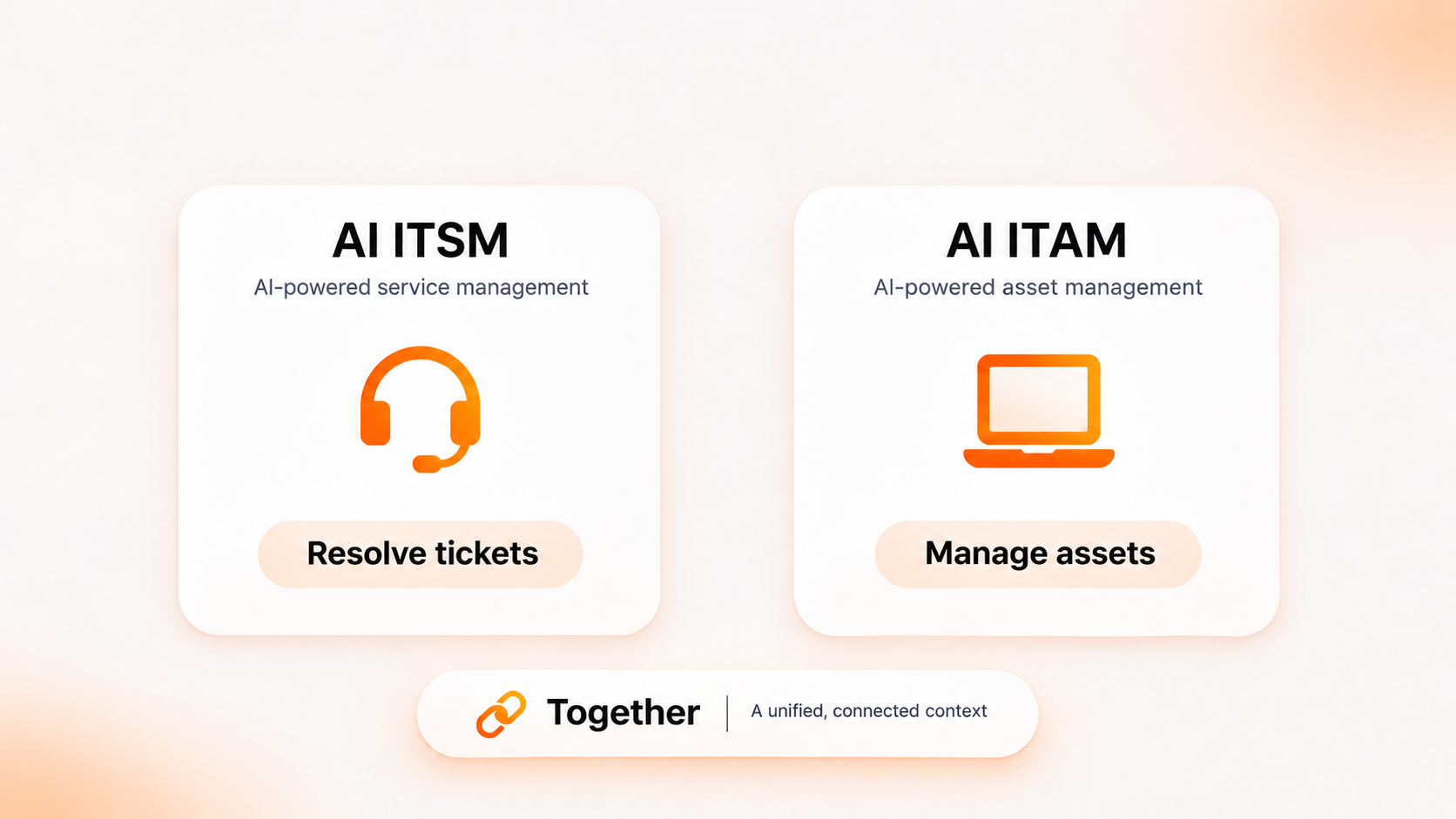
AI ITSM applies machine learning, natural language processing and AI agents to service delivery, so tickets get classified, routed and resolved faster. AI ITAM applies the same technology to the asset estate, so hardware and software records stay accurate, costs stay visible and lifecycle decisions are made on time. One improves how IT responds. The other improves what IT knows.
ITSM vs ITAM
Before adding AI, it helps to be clear on the disciplines themselves.
- ITSM (IT service management) covers how IT delivers and supports services: incidents, requests, problems and changes. ITIL 4 is the most widely used framework.
- ITAM (IT asset management) covers the full lifecycle of hardware and software, from procurement to retirement, including contracts, licenses and cost.
- The CMDB holds configuration items and their relationships. It sits between the two, giving service teams technical context about the assets ITAM manages.
For a deeper breakdown, see our guides to ITSM vs ITIL and CMDB vs ITAM.
What does AI do in ITSM?
AI in ITSM focuses on the ticket lifecycle. The goal is fewer touches per request, faster resolution and a service desk that scales without adding headcount at the same rate.
Ticket triage, routing and summarization
AI reads incoming requests, assigns category and priority, and routes them to the right queue. It can also summarize long ticket threads, so an L2 engineer picks up context in seconds instead of scrolling through ten replies.
Virtual agents and self-service
Conversational agents in Slack, Microsoft Teams or a portal answer common questions and walk employees through fixes. When they work well, they deflect repetitive L1 volume like “how do I connect to the VPN.”
Automated resolution and root-cause analysis
More advanced tools act, not just answer. They reset passwords, provision access or restart services, then confirm the fix worked. On the incident side, AI can correlate alerts across systems to point engineers toward a likely root cause.
Change risk and knowledge generation
AI can score change requests by risk based on past outcomes and draft knowledge articles from resolved tickets, which keeps the knowledge base current without a dedicated writer.
What does AI do in ITAM?
AI in ITAM focuses on data quality and decisions. The goal is an asset inventory that is accurate, enriched and connected to cost.
Discovery, normalization and lifecycle enrichment
Discovery tools often return the same device under three names. AI can normalize and deduplicate records, then enrich them with warranty, end-of-life and end-of-support dates. That turns a raw device list into something an analyst, or an agent, can trust.
Predictive failure and refresh planning
By analyzing device age, performance signals and repair history, AI can flag hardware likely to fail and help IT plan refreshes by cohort instead of reacting one broken laptop at a time.
License optimization and renewal forecasting
AI compares license entitlements against actual usage to surface drift: seats paid for but unused, or usage that exceeds what was purchased. That supports better renewal negotiations and fewer audit surprises.
Shadow IT and shadow AI discovery
Employees now sign up for AI tools as casually as they once did for file-sharing apps. AI-assisted discovery can help ITAM teams find unsanctioned SaaS and AI tools, which turns asset management into a practical governance layer for shadow AI.
AI ITSM vs AI ITAM: side-by-side comparison
| Dimension | AI in ITSM | AI in ITAM |
|---|---|---|
| Core goal | Faster, lower-cost service delivery | Accurate, cost-optimized asset estate |
| Primary data | Tickets, conversations, knowledge base, telemetry | Discovery scans, contracts, licenses, purchase and lifecycle records |
| Typical AI tasks | Triage, routing, virtual agents, auto-resolution, root-cause analysis | Normalization, enrichment, failure prediction, license drift, anomaly detection |
| Key metrics | MTTR, ticket deflection, first-contact resolution, SLA compliance | License utilization, record accuracy, audit findings, recovery value |
| Main users | Service desk agents, employees | Asset managers, Finance, Procurement, Security |
| Biggest risk | Wrong action or answer at scale | Bad data amplified into bad decisions |
| Depends on | Asset context: owner, warranty, installed software, lifecycle stage | Service signals: incidents, requests, usage patterns |
The last row matters most. Each side runs on data the other side owns.
What is AI-powered ITSM?
AI-powered ITSM is IT service management that uses machine learning, natural language processing and AI agents to classify, resolve and predict service issues with less manual effort. It ranges from simple chatbots that retrieve knowledge articles to agents that complete multi-step fixes across connected systems, with humans approving higher-risk actions.
From chatbots to agentic IT: four levels of AI maturity
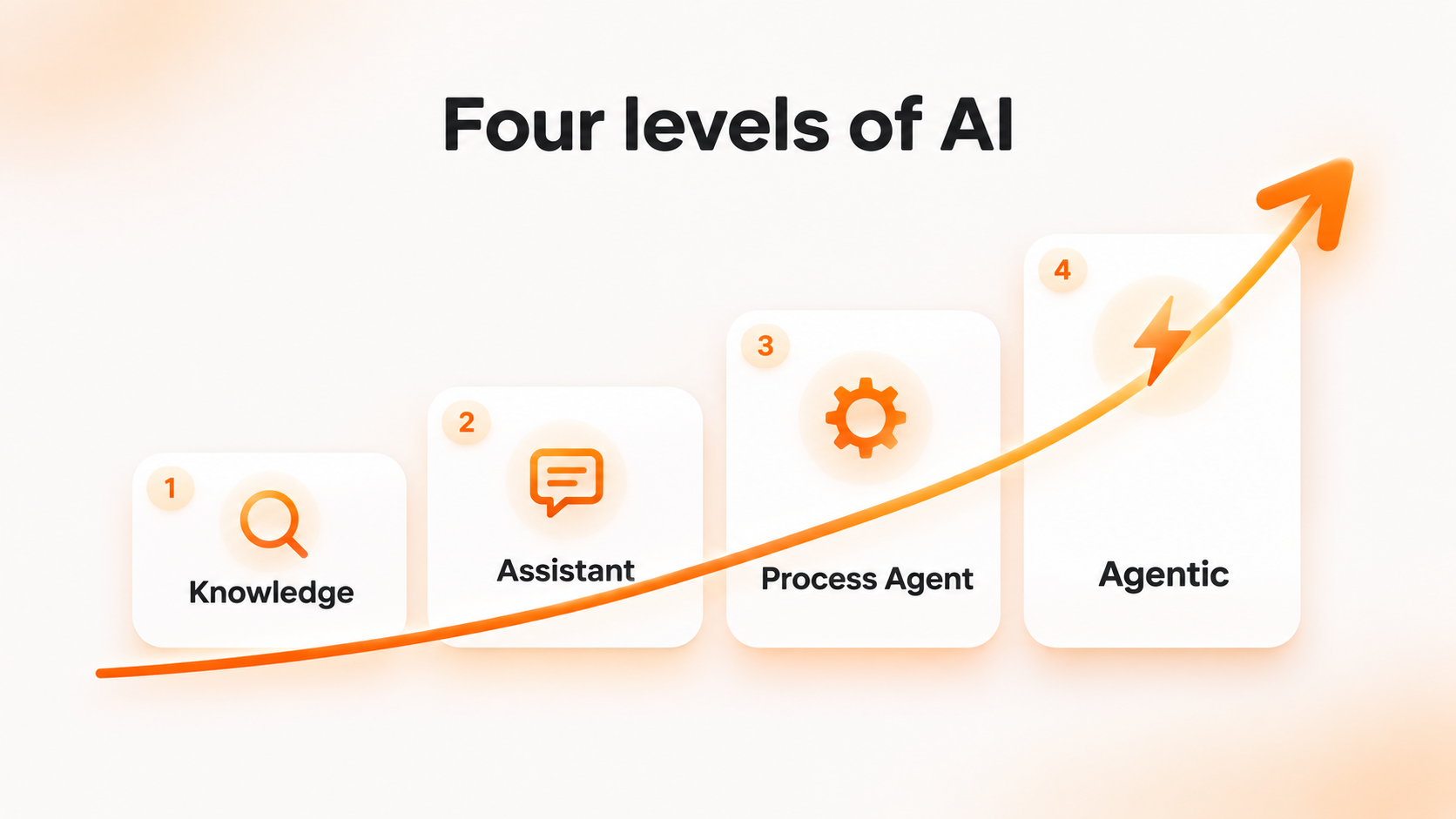
Not all “AI” in IT tools is the same. A useful way to evaluate vendors is by what the AI can actually do.
| Level | What it does | ITSM example | ITAM example |
|---|---|---|---|
| 1. Knowledge retrieval | Finds and returns information | Suggests a KB article | Answers “how many MacBooks do we have?” |
| 2. AI assistant | Drafts, summarizes and recommends | Summarizes a ticket, suggests a fix | Flags devices nearing end of warranty |
| 3. Process agent | Executes a defined workflow | Resets a password and closes the ticket | Starts a recovery workflow at offboarding |
| 4. Agentic | Plans and acts across systems toward a goal | Diagnoses an issue, checks the asset, orders a replacement, updates the record | Plans a refresh cohort and triggers procurement within budget rules |
The jump from level 2 to level 3 is where generative AI (conversational) becomes agentic AI (operational). Agentic IT is the operating model where AI agents carry out multi-step IT work across service, asset and lifecycle systems, inside guardrails set by the IT team.
Adoption is moving quickly. Gartner predicts up to 40% of enterprise applications will include task-specific AI agents by 2026, up from less than 5% in 2025.
Why AI service management breaks without asset data
AI agents act on whatever data they are given. If asset records are stale, duplicated or disconnected from the service desk, the agent doesn’t slow down. It makes the wrong call faster.
IDC makes a similar point in its analysis of AI in ITSM, arguing that data quality, with a strong CMDB as the foundation, decides whether AI initiatives in service management deliver results.
One ticket, three outcomes
An employee submits: “My laptop is really slow and keeps freezing.”
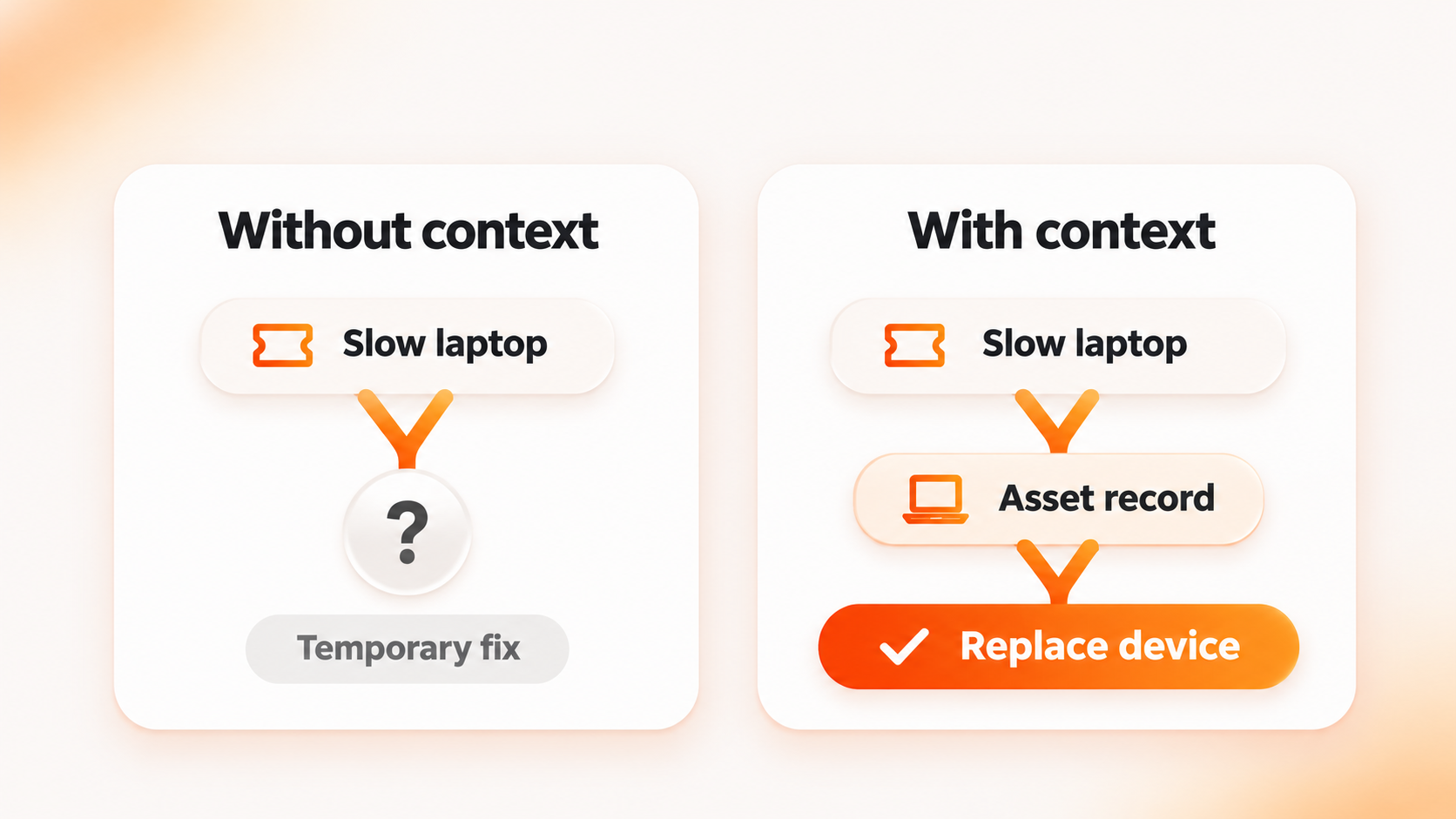
AI ITSM alone. The virtual agent recognizes a performance issue, suggests clearing cache and restarting, then closes the ticket. Three days later, the ticket reopens. The agent never knew the device was four years old with a failing drive.
AI ITAM alone. The asset platform correctly flags the laptop as past its refresh date and at risk of failure. But that insight sits in a dashboard. Nobody on the service desk sees it while the employee is waiting.
Both connected. The agent reads the ticket, pulls the asset record and sees the device age, warranty status and prior repair history. It routes a replacement request, schedules recovery of the old laptop and updates the asset record once the new device ships. The employee gets a fix, not a workaround, and the inventory stays accurate.
That is why AI ITSM vs AI ITAM is a false choice. The value shows up where the two meet.
When the AI can’t see the laptop, it guesses
Most AI service desks were built on ticket data alone. Most ITAM tools were built for asset managers, not for agents resolving requests in real time. Unduit was built to close that gap, combining ITSM, ITAM and physical asset lifecycle services in one platform, so the AI has full context and can act on it.
- Asset context on every ticket: Device, owner, warranty and lifecycle details appear automatically when a request comes in, so agents and AI start with the full picture.
- AI across ITAM and ITSM: AI-enabled capabilities span both the service desk and the asset inventory, aimed at fewer manual steps and faster resolution.
- Full device lifecycle: Procurement, deployment, tracking, recovery, repair, buyback and recycling in 100+ countries, so a “replace this laptop” decision can be executed, not just recommended.
- Works with your stack: Integrations with Jira, MDMs such as Jamf, Iru (formerly Kandji) and Microsoft Intune, and HRIS platforms keep asset and employee data in sync.
- Auditable chain of custody: Every device movement is logged, which supports compliance and security reviews.
If your team already runs Jira, Unduit works alongside it rather than replacing it.
How much does AI ITSM vs AI ITAM cost?
Pricing varies widely, and published list prices rarely tell the full story. Common models include:
- Per agent or per technician (typical for ITSM)
- Per asset or per device (typical for ITAM)
- Per resolution or per conversation (common with AI-native service desks)
- AI add-on SKUs layered on top of an existing license
The hidden costs are often larger than the license: cleaning up asset data, building integrations and tuning workflows. ROI also shows up differently. AI ITSM returns value through deflection and lower cost per ticket. AI ITAM returns value through license savings, avoided audit findings and higher hardware recovery value. Vendor pricing and packaging change often, so compare current quotes and plan documentation before deciding.
Risks and guardrails for AI in IT
Agentic AI is promising, but it is not plug-and-play. Gartner expects more than 40% of agentic AI projects to be canceled by the end of 2027 due to rising costs and unclear business value, and warns about “agent washing,” where existing chatbots are rebranded as agents.
Practical guardrails to put in place:
- Approval thresholds: Let AI act alone on low-risk tasks; require human approval for access changes, purchases and anything affecting production.
- Scoped permissions: Give agents the minimum access each workflow needs.
- Audit trails: Log every AI action and the data it relied on.
- Prompt injection defenses: Treat ticket text and email content as untrusted input.
- Quality metrics: Track reopen rates, not just deflection. A closed ticket that reopens isn’t a win.
- Data privacy: Review how employee and device data is processed, including state privacy laws such as the CCPA where applicable.
How to get started: a four-step path
- Clean and structure your asset inventory. Deduplicate records, assign owners and fill in warranty and lifecycle dates.
- Connect asset and ticket data. Link devices and software to users and configuration items, so every ticket carries context.
- Set governance. Decide what AI can do alone, what needs approval and who reviews outcomes.
- Start with low-risk, high-volume use cases. Natural-language inventory search, ticket triage and record enrichment are good first steps. Expand to agentic actions once accuracy is proven.
FAQ
What is AI-powered ITSM?
AI-powered ITSM uses machine learning, natural language processing and AI agents to triage, resolve and predict IT service issues. It reduces repetitive L1 work and speeds up resolution, with humans handling exceptions and approvals.
What is the difference between ITSM and ITAM?
ITSM manages how IT services are delivered and supported. ITAM manages the lifecycle, cost and compliance of hardware and software assets. They share data, often through a CMDB.
Is ServiceNow an ITAM tool?
ServiceNow is primarily known for ITSM, but it offers ITAM capabilities through its hardware and software asset management modules, which run on the same platform.
What’s the difference between ITAM and a CMDB?
ITAM covers the financial, contractual and lifecycle side of assets. A CMDB stores configuration items and how they relate to services. Read our CMDB vs ITAM guide for more.
ITSM vs ITOM vs ITAM: what’s the difference?
ITSM handles service delivery and support. ITOM (IT operations management) handles infrastructure monitoring and performance. ITAM handles asset lifecycle and cost.
What is agentic IT?
Agentic IT is an operating model where AI agents complete multi-step IT tasks across systems, such as diagnosing an issue, checking the asset record and ordering a replacement, within guardrails set by the IT team.
Will AI replace the IT help desk?
Not entirely. AI can take on much of the repetitive L1 workload, but people still handle complex issues, judgment calls, approvals and employee relationships.
Do I need AI ITSM and AI ITAM, or just one?
Most teams benefit from both. AI in ITSM resolves issues faster when it can see asset data, and AI in ITAM delivers more value when its insights reach the service desk.