An IT team can close 400 tickets a month and still lose track of the laptops behind them. That gap is usually where the ITSM vs ITIL conversation starts. One person asks whether the team “does ITIL,” another says “we have an ITSM tool,” and both assume they mean the same thing.
They don’t.
TL;DR:
- ITSM (IT service management) is the practice of designing, delivering, and supporting IT services.
- ITIL is the most widely used framework of best practices for doing ITSM.
- Every IT team does ITSM in some form. ITIL is optional guidance on how to do it well.
What Is ITSM?
ITSM is how an IT team delivers technology to the people who use it. It covers everything from password resets to shipping a new hire’s laptop to rolling out updates across 2,000 devices.
ITSM is people, process, and technology working together. It isn’t a piece of software. A team running on a shared inbox and a spreadsheet is still doing ITSM, just not efficiently.
Core ITSM activities include:
- Incident management
- Service request management
- Change management
- Problem management
- IT asset management
- Knowledge management and self-service
What Is ITIL?
ITIL is a framework of best practices for IT service management. It gives teams shared terminology, proven processes, and guiding principles so they don’t build service management from scratch.
ITIL is descriptive, not prescriptive. Teams adopt what fits and adapt the rest.
ITSM vs ITIL: Key Differences
Think of it this way: ITIL is to ITSM what Agile is to project management. One is the discipline. The other is a well-known way to practice it.
Both share the same goal: reliable services, clear processes, measurable service levels, and continual improvement. That’s why most teams never have to choose between them.
What ITSM vs ITIL Looks Like in Practice
A remote sales manager in Denver spills coffee on her laptop the day before a client pitch.
Without a framework:
- She messages a technician she knows. He’s out, so she tries someone else.
- IT ships a spare from the office closet. Nobody logs which one.
- The damaged laptop sits in her home office for six weeks.
- At audit time, the asset register still shows the old device assigned to her.
With ITIL-aligned ITSM:
- Incident: The ticket is logged, prioritized, and routed.
- Service request: A replacement device request is triggered.
- Change: The new laptop is provisioned through a standard, preapproved change.
- Asset update: The new device is assigned and the old one is flagged for recovery.
- Recovery and retirement: A return kit ships, the device is tracked in transit, then assessed for repair, redeployment, or certified data destruction.
ITIL didn’t fix the laptop. It made every step visible, owned, and auditable.
Streamline IT Service Management with Unduit
Automate requests, manage assets, and deliver better IT support from one platform.
Get demoWhat Are the “5 Stages” of ITIL?
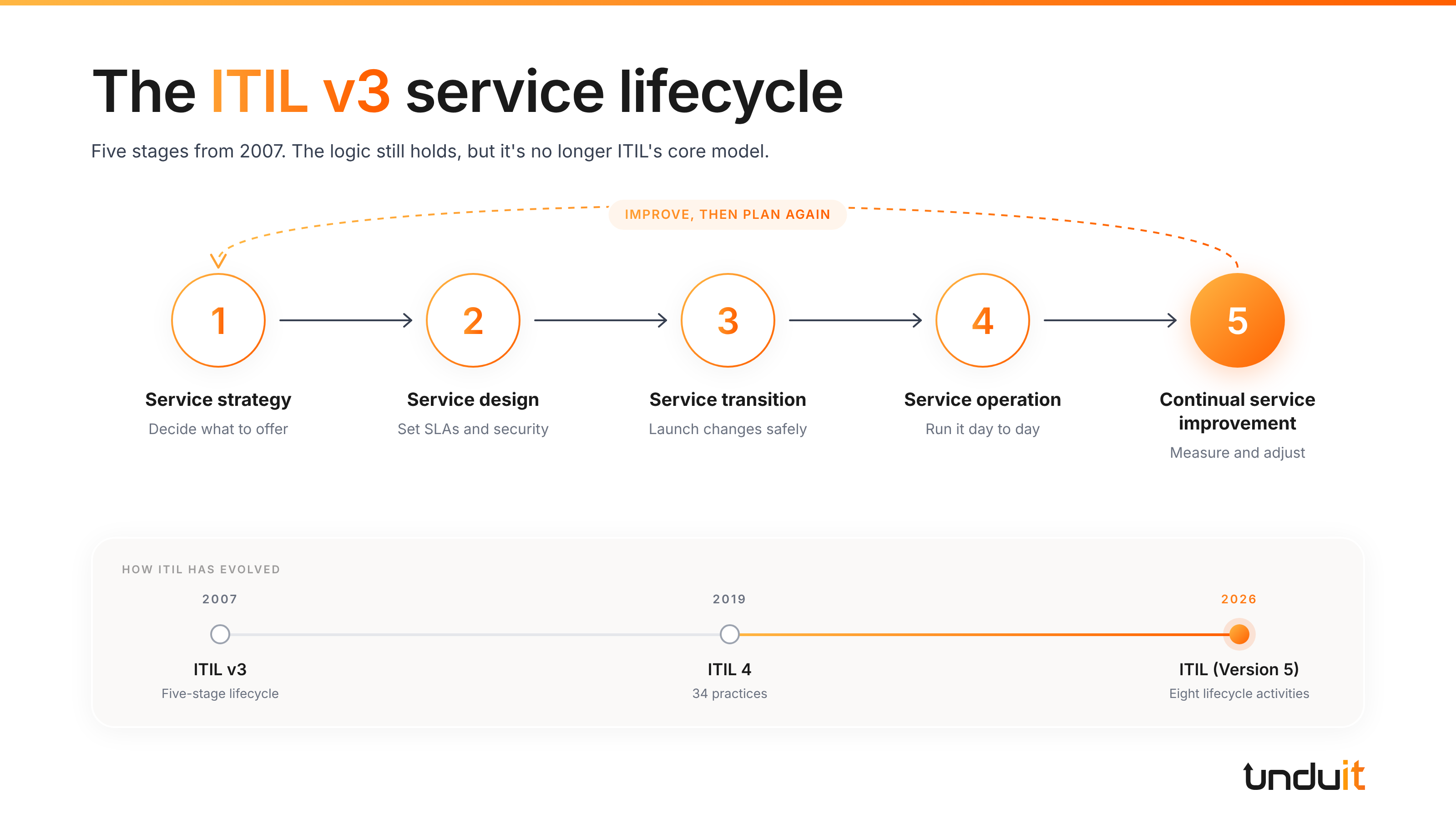
This is one of the most common points of confusion. The “5 stages” (service strategy, design, transition, operation, and continual service improvement) are ITIL v3’s service lifecycle from 2007. They aren’t stages of ITSM, and they haven’t been ITIL’s core model since 2019.
The model still shows up in job descriptions, vendor pages, and older training material, so it’s worth knowing what each stage covers:
The logic still holds. Plan it, design it, launch it, run it, and improve it. The problem is the strict sequence. Real IT work rarely moves in a straight line, which is why later versions of ITIL replaced the lifecycle with a more flexible model.
ITIL (Version 5) organizes work into eight activities: Discover, Design, Acquire, Build, Transition, Operate, Deliver, and Support.
Is ITIL Still Relevant in 2026?
Yes. ITIL 4 answered most of the “too rigid for Agile and DevOps” criticism. ITIL (Version 5) goes further. According to PeopleCert, it is:
- AI-native: written with AI use and AI governance in mind
- Product and service unified: treats digital products and services as one solution
- Built for complexity: supports experimentation, not just plan execution
The ITIL Foundation (Version 5) exam went live in February 2026, and ITIL 4 continues to run in parallel during the transition. The guiding principles and core practices haven’t gone anywhere.
ITSM vs ITIL vs ITOM
ITSM is the user-facing view. ITOM is the back-end view. ITIL offers guidance for both, and IT asset lifecycle management ties them to what the business actually owns.
Do You Need ITIL to Do ITSM Well?
No. Most teams benefit from borrowing the parts that solve today’s problems. For organizations with 500 to 5,000 employees, an Adopt / Adapt / Skip filter keeps it practical.
The goal isn’t ITIL compliance. It’s fewer repeat incidents, faster fulfillment, and cleaner audits.
Your Tickets Follow ITIL. Do Your Laptops?
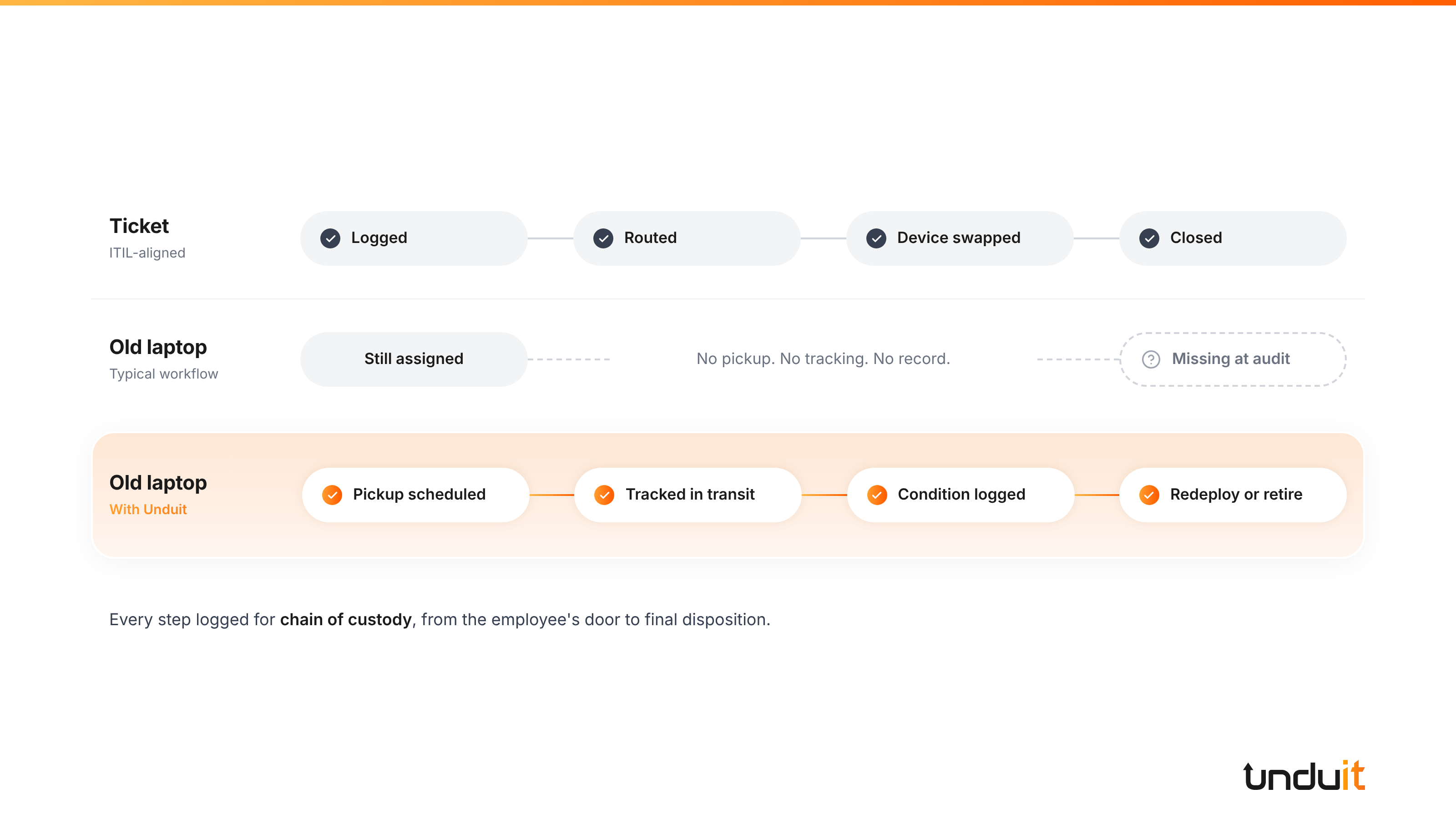
Most mid-market teams adopt incident and change management first. Asset management comes last, and that’s where the gaps appear. The ticket closes, the replacement ships, and the old device quietly disappears.
For distributed teams, IT asset recovery is often the weakest link in the service chain. Unduit closes that gap inside the service workflow, connecting each ticket to the device behind it from procurement and deployment through recovery and retirement:
- Automated pickup scheduling: sends reminders and arranges device pickups without manual follow-up
- Real-time tracking dashboard: monitors laptops, monitors, and peripherals in transit from anywhere
- Smart inventory updates: logs returned devices, records condition, and updates your asset records
- Refurbish and redeploy recommendations: suggests repair, upgrade, or redeployment options to maximize asset value
- Secure chain of custody: logs every step for compliance and data security
- Global support: handles domestic and international shipments
- Employee-friendly communication: sends timely updates by email, text, or call
Unduit also works alongside the tools you already run, including Jira, MDMs like Jamf and Microsoft Intune, and HRIS platforms.
FAQs
Q1: What is the main difference between ITSM and ITIL?
ITSM is the practice of managing IT services. ITIL is a framework of best practices for doing ITSM well.
Q2: What are the 5 stages of ITSM?
The “5 stages” come from ITIL v3’s service lifecycle, not ITSM itself. ITIL 4 replaced them in 2019, and ITIL (Version 5) now uses eight lifecycle activities.
Q3: Is ITIL still relevant in 2026?
Yes. ITIL (Version 5) launched in early 2026 with AI-native guidance and a unified product and service lifecycle.
Q4: What is the difference between ITIL and ITOM?
ITIL is a best-practice framework. ITOM is the practice of running IT infrastructure through monitoring, event management, and capacity planning.
Q5: Is Jira an ITSM tool?
Jira Service Management is an ITSM tool and supports ITIL-aligned workflows. Jira Software on its own is built for development work.
Q6: Can you do ITSM without ITIL?
Yes. ITIL is optional. Many teams use parts of it, other frameworks like COBIT or ISO/IEC 20000, or their own processes.