Imagine a small SaaS startup with 25 employees. Their IT team handles everything from user account issues to server outages. On average, tickets take 12 hours to resolve, 18% of devices go untracked, and change requests frequently break dependencies. Chaos, downtime, and frustrated staff are the norm.
Key Takeaways
- ITSM for small businesses brings structure to IT operations, reducing chaos, downtime, and untracked systems.
- It improves efficiency by speeding up ticket resolution, standardizing workflows, and reducing repeat incidents.
- Core ITSM processes like incident, change, and asset management are essential for stable and scalable IT operations.
- Choosing the right ITSM tool and scaling at the right time helps improve ROI, visibility, and long-term business growth.
This scenario is common across small businesses. ITSM for small businesses offers a structured approach to manage IT services, reduce downtime, and improve service delivery.
What is ITSM for Small Businesses?
ITSM for small businesses (IT Service Management) is the practice of designing, delivering, and improving IT services aligned with business goals. Implementing ITSM effectively can turn reactive IT operations into proactive, measurable, and accountable processes.
For IT managers and operations leads, the key is not just knowing what ITSM is, but understanding benefits of ITSM for small businesses, knowing how to implement ITSM, and choosing the right tools that fit the scale and budget of an SMB.
Benefits of ITSM for Small Businesses
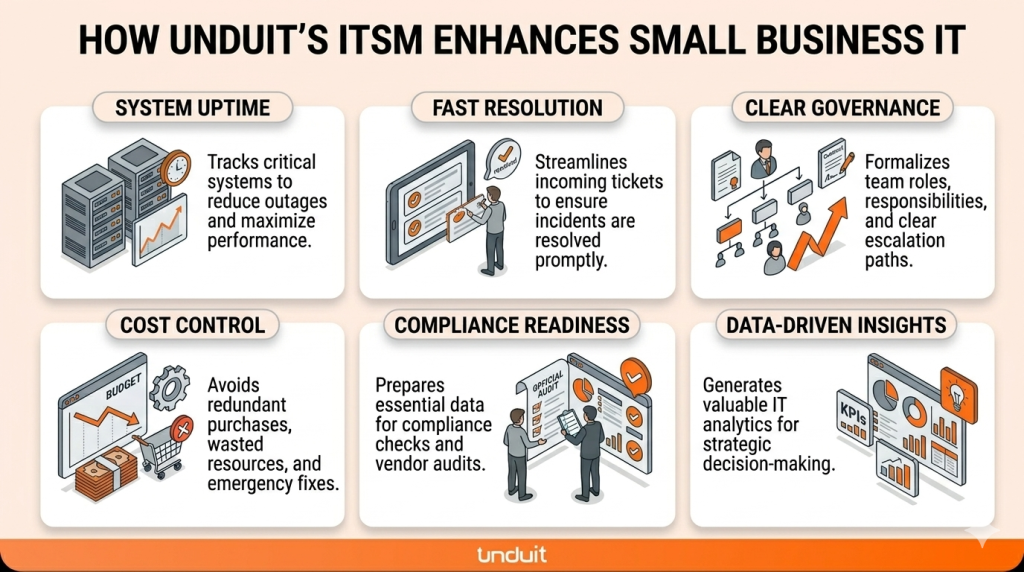
Even small IT teams benefit immensely from structured service management. Key advantages include:
- Improved uptime: Reduce outages and downtime across critical systems.
- Faster resolution: Streamlined ticketing ensures incidents are resolved promptly.
- Clear governance: Roles, responsibilities, and escalation paths become formalized.
- Cost control: Avoid redundant purchases, wasted resources, and emergency fixes.
- Audit readiness: Be prepared for compliance checks or vendor audits.
Key Terms Every IT Leader Should Understand
Before diving into processes and tools, it’s important to clarify terminology:
- ITSM: A set of practices for delivering IT services aligned with business goals. Focuses on processes, people, and technology.
- ITIL: A widely adopted framework that guides ITSM best practices. ITIL 4 emphasizes value streams, agile integration, and modern service delivery.
- CMDB & ITAM: A configuration management database (CMDB) tracks assets, relationships, and dependencies. IT asset lifecycle management (ITALM) complements ITSM by ensuring devices, licenses, and cloud services are accounted for and optimized.
| Concept | Purpose | Key Focus |
|---|---|---|
| ITSM | Deliver IT services aligned with business goals | Processes, outcomes, people, technology |
| ITIL | Framework for ITSM | Best practices, continual improvement, service value |
| CMDB | Track assets, configurations, and dependencies | IT asset relationships, lifecycle data, dependencies |
| ITAM | Manage IT assets throughout their lifecycle | Devices, licenses, cloud resources, optimization |
Essential ITSM Capabilities for Growing Teams
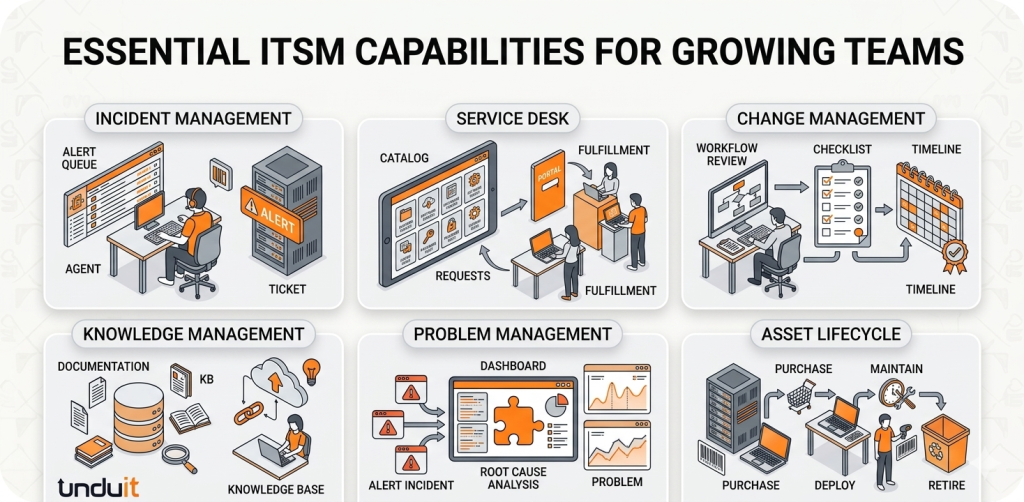
For small and medium-sized businesses (SMBs), focusing on ITSM processes that deliver the highest impact with feasible implementation ensures a faster return on investment. Here’s a practical breakdown of the essential processes to prioritize:
1. Incident Management
- Focus: Quickly resolve IT disruptions to minimize downtime.
- MVP Practices: Centralized ticketing system, clearly defined escalation paths.
- KPI: Mean Time to Resolution (MTTR).
2. Service Desk & Request Fulfillment
- Focus: Provide a single point of contact for users.
- MVP Practices: Self-service portal, defined SLAs, ticket categorization.
- KPI: First Contact Resolution (FCR).
3. Change Management
- Focus: Manage changes in a controlled way to reduce outages.
- MVP Practices: Approval workflows, risk assessments, communication plans.
- KPI: Change success rate.
4. Knowledge Management
- Focus: Capture and reuse solutions for recurring issues.
- MVP Practices: Centralized knowledge base, link articles to tickets.
- KPI: Knowledge Base deflection rate.
5. Problem Management
- Focus: Identify root causes to prevent repeat incidents.
- MVP Practices: Trend analysis, root-cause tracking, proactive fixes.
- KPI: Reduction in repeat incidents.
6. ITAM / Asset Lifecycle Management
- Focus: Track, optimize, and recover IT assets efficiently.
- MVP Practices: Inventory tracking, procurement records, end-of-life management.
- KPI: Asset recovery rate.
Key Factors to Consider During Evaluation
Choosing the right ITSM tool requires more than comparing feature lists. A structured evaluation helps ensure the platform meets your current needs, supports future growth, and delivers value without unnecessary complexity or cost. Focus on business requirements, ease of adoption, integration capabilities, and overall return on investment.
Four-Step Decision Framework
- Map Your Needs
- Identify the ITSM processes you want to support.
- Define reporting, automation, and integration requirements.
- Consider future scalability and business growth.
- Assess Core Features
- Ticketing and workflow management
- Asset and configuration management (ITAM/CMDB)
- Automation and reporting capabilities
- APIs and self-service options
- Review Integration Capabilities
- Ensure compatibility with existing tools and platforms.
- Look for integrations with collaboration, productivity, and cloud services.
- Minimize manual work by connecting key systems.
- Evaluate Cost and Time-to-Value
- Compare pricing models and licensing costs.
- Assess implementation and training requirements.
- Estimate the expected ROI and speed of deployment.
Signs You’ve Outgrown Basic ITSM
As organizations grow, their IT requirements become more complex. If your current tools and processes are struggling to keep pace with business demands, it may be time to move to an enterprise ITSM platform or partner with a managed service provider. Scaling at the right time helps improve efficiency, maintain service quality, and support future growth.
Common Signs It’s Time to Scale
- Complex integrations across multiple business systems
- Increasing compliance, governance, or audit requirements
- High volume of change requests and approvals
- Operations spanning multiple locations or regions
- IT teams spending too much time on routine operational tasks
- Growing need for advanced reporting, analytics, and visibility
One Platform for ITSM and ITAM
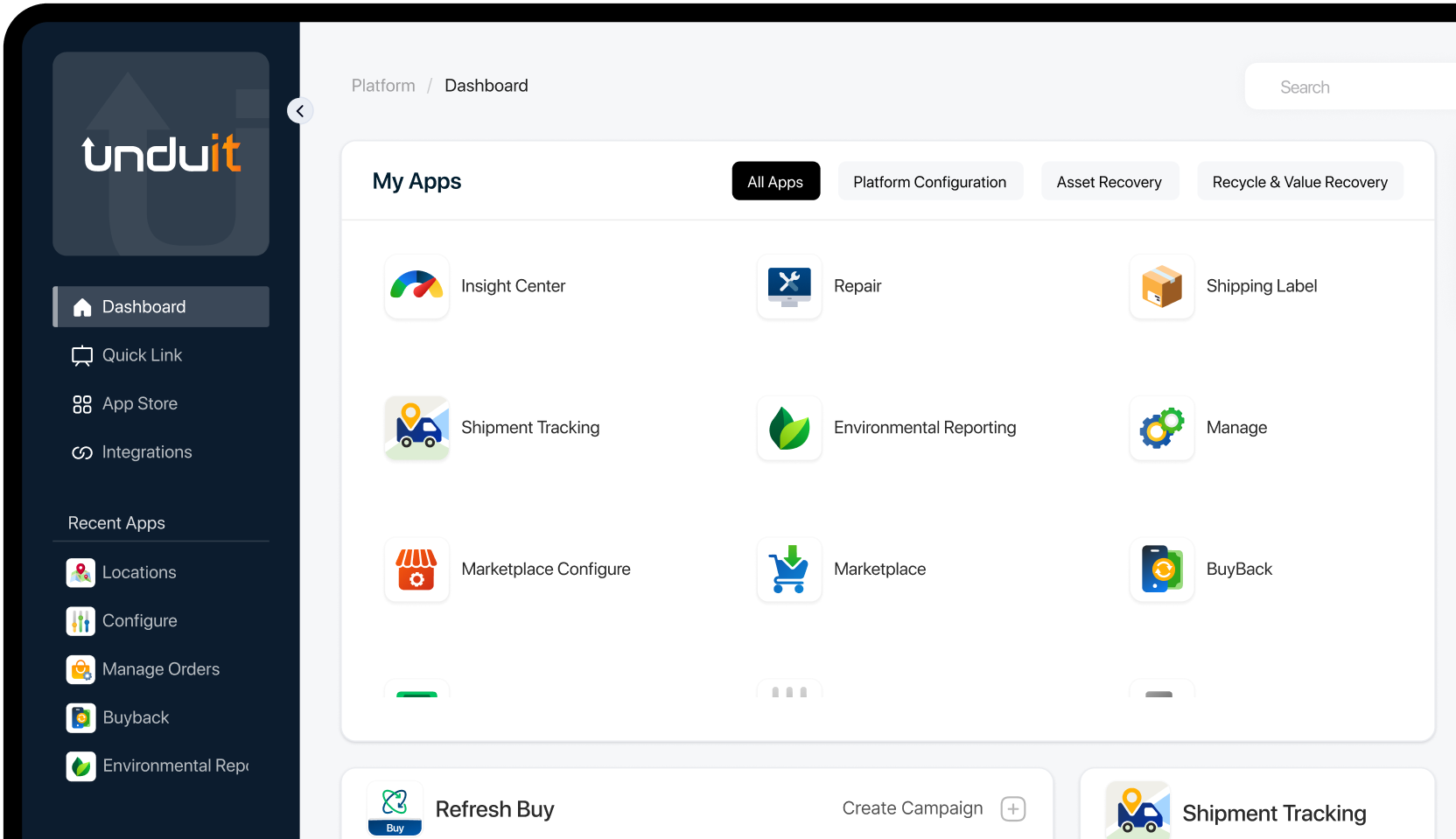
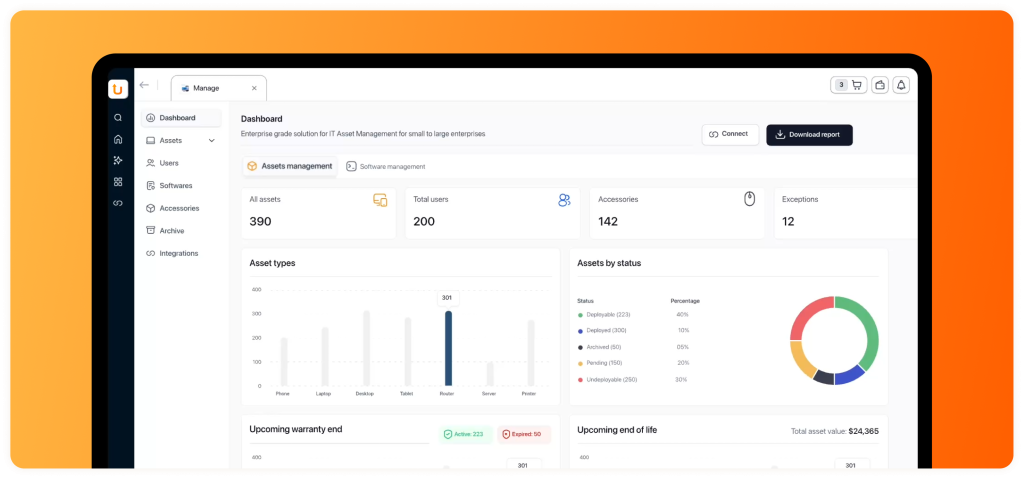
Unduit offers one platform that connects IT service management with full asset lifecycle control. It combines ticketing, automated workflows, real-time tracking, and lifecycle management in one place.
Unduit helps IT teams:
- Stay on top of service requests and asset status.
- Automate routine tasks and track service levels.
- See asset health from procurement through recovery.
- Manage global assets and logistics without extra tools.
If you want a clear view of your IT services and assets, plus a simpler way to stay in control, Unduit is built for you.
FAQs
What are the 5 stages of ITSM?
The 5 key stages of ITSM are Service Strategy, Service Design, Service Transition, Service Operation, and Continual Service Improvement. Together, they create a structured lifecycle for delivering and improving IT services aligned with business needs.
What is the best IT solution for a small business?
There’s no one-size-fits-all answer, but the best IT solution is usually a scalable platform that combines helpdesk ticketing, automation, and asset management. Small businesses benefit most from tools that reduce manual work and grow with their needs.
What is ITSM in business?
ITSM (IT Service Management) is the practice of designing, delivering, and managing IT services in a structured way. In business, it helps align IT operations with business goals, improving reliability, efficiency, and user satisfaction.
What are the IT basics for small business?
At a minimum, small businesses need reliable helpdesk support, secure device and user management, data backups, and basic cybersecurity controls. As they grow, structured ITSM processes help bring consistency and control to these functions.
How does ITSM improve IT efficiency and service delivery?
ITSM improves efficiency by standardizing workflows, automating repetitive tasks, and improving visibility into IT operations. This leads to faster issue resolution, fewer errors, and more consistent service delivery across the organization.